5 Fyno features that will change your customer communication strategy
TL;DR
If your team built a notification system but critical messages still fail, costs keep rising, and every provider or channel change turns into weeks of work, you’re not alone. Fyno was built for this exact pain. Its five strategy-shifting features are: opti-channel messaging (right channel per customer), no-code workflows (changes without sprints), smart routing + failover (near-perfect deliverability), centralized templates (consistent and compliant), and cost optimization (visibility + cheaper routing).
Why do customer communication systems keep becoming engineering bottlenecks?
Because messaging is never “done.” Your engineering team can spend quarters building a notification system—yet critical messages still fail, costs spiral, and switching providers or adding channels keeps demanding weeks of development. Communication infrastructure becomes a silent productivity killer when developers spend their time patching notification logic instead of building the core product.
The hidden cost of “building notifications in-house”
Every workflow needs logic for: when to send, which channel to use, what happens on failure, how to track delivery/read, and what to do on replies. Then come provider integrations, ongoing optimization, and constant maintenance. The outcome is predictable: engineering time gets consumed, non-technical teams wait for small updates, and customers still miss important notifications when a channel fails.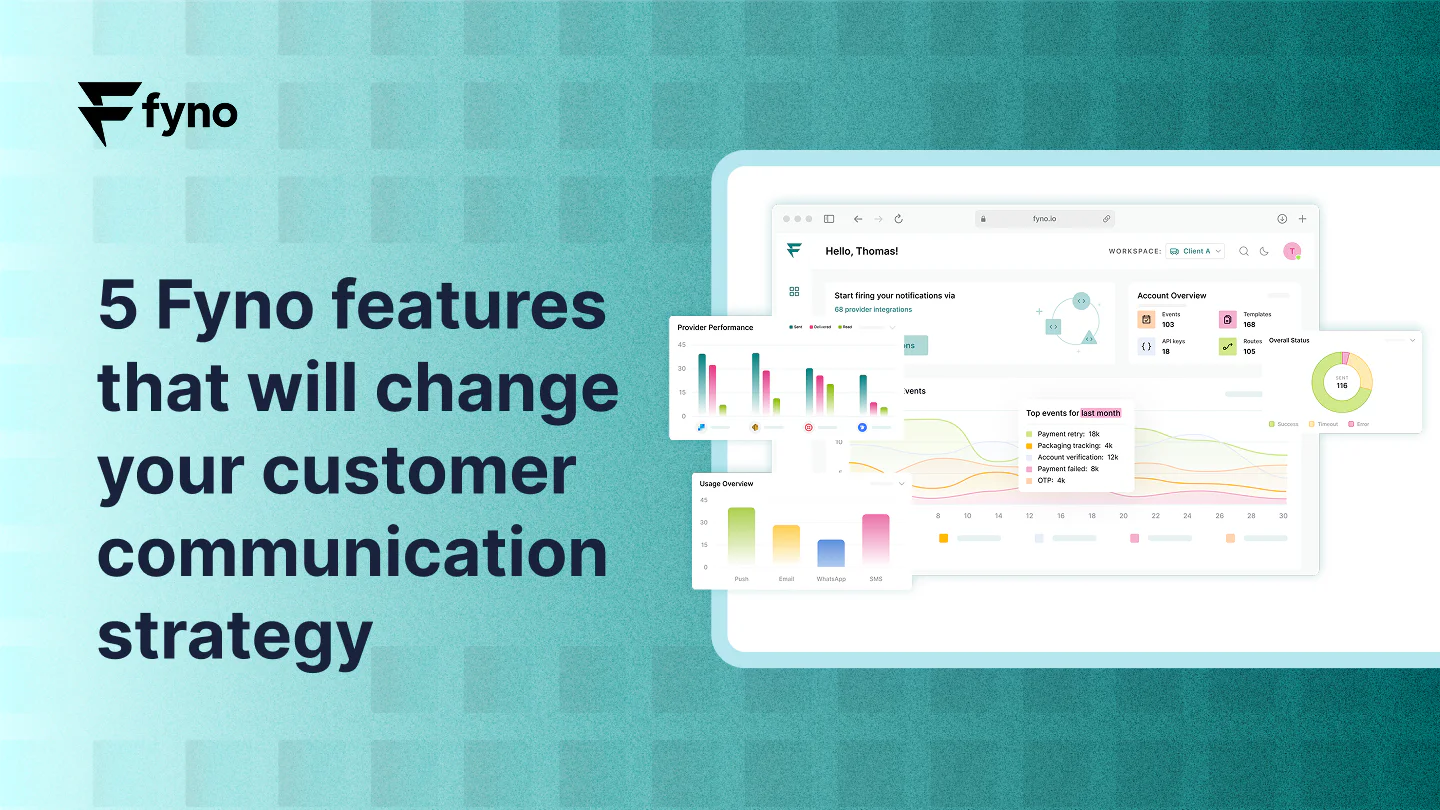
What are the 5 Fyno features that change your communication strategy?
Fyno positions these five capabilities as “game-changers” because they shift messaging from scattered integrations to a controlled strategy layer. Instead of adding more tools, you standardize how messages are routed, delivered, governed, and optimized—without repeatedly touching your codebase.
Feature 1: Opti-channel messaging that reaches customers where they are
Forget multichannel or even omnichannel approaches. Fyno takes customer communication to the next level with opti-channel messaging. Unlike traditional methods that focus on making multiple channels available, the opti-channel approach prioritizes delivering the right message through the right channel at the right time for each individual customer.
Imagine this: A customer in a tier 1 city might prefer receiving transaction confirmations via WhatsApp but marketing messages through email. Meanwhile, a customer in a tier 2 town might prefer all communications on SMS due to limited internet connectivity.
Fyno's intelligent opti-channel system analyzes customer preferences, past interactions, and message types to automatically select the most effective channel for each situation.
This targeted approach leads to higher open and response rates, deeper customer insights, and significantly reduced costs compared to sending messages on all channels at once, which many businesses resort to.
Feature 2: No-code workflow builder that puts you in control
One of the biggest challenges with communication infrastructure is the constant need for engineering resources to make even minor changes. Want to switch SMS providers? That's a sprint. Need to update a message template? Get in line for the next deployment.
Fyno's no-code workflow builder changes all that. It offers a centralized, user-friendly platform where your entire team (not just engineers) can seamlessly manage multiple communication channels, create workflows, and control templates.
The best part? Changes you make to workflows or parameters won't affect API endpoints, eliminating the need for lengthy planning or sprint cycles to deploy updates.
With Fyno, your product and marketing teams can design sophisticated workflows based on user attributes like subscription status, location, or behavior. They can deliver personalized notifications that resonate with specific audience segments, boosting engagement and conversion rates – all without touching a single line of code.
Feature 3: Smart routing and failover to ensure 100% deliverability
Nothing damages customer trust faster than missed notifications. Whether it's a time-sensitive security alert or an important account update, your customers expect reliable communication.
Fyno's intelligent routing and failover systems make sure your notifications get through, even when a primary channel experiences issues. If an SMS fails to deliver, the system automatically tries WhatsApp. If that fails, it moves to email, and so on – all based on your predefined preferences and rules.
This level of reliability is especially crucial for financial institutions and logistics companies, where missed messages can lead to serious customer concerns and support tickets. With Fyno, you can achieve near-perfect deliverability rates, ensuring critical information always reaches your customers regardless of channel failures or network issues.
Feature 4: Centralized template management for consistent messaging
Managing message templates across multiple channels and providers is a logistical nightmare for most businesses. Different character limits, formatting requirements, and approval processes create inconsistent messaging and endless headaches.
Fyno solves this with centralized template management. You can create, store, and manage messaging templates for all communication channels in one intuitive interface. The "What You See Is What You Get" editor simplifies template creation, allowing users to design professional, on-brand templates without technical knowledge.
For businesses dealing with regulatory requirements like DLT registration for SMS in India, Fyno even streamlines content template approvals. Instead of juggling multiple portals for different telecoms, you can manage everything from within Fyno, saving enormous amounts of time and ensuring compliance across all your messaging.
Feature 5: Cost optimization that reduces expenses while improving results
Most businesses have no idea how much they're really spending on customer communications. Developer hours, infrastructure expenses, and messaging costs across multiple providers quickly add up, but the lack of centralized tracking makes it impossible to optimize.
Fyno's cost optimization features bring visibility and control to your communication expenses. The platform's opti-channel approach analyzes which channels perform best for different interactions, offering data-driven recommendations to improve your communication workflows. By intelligently selecting the most cost-effective channel for each message type, you can reduce communication costs by up to 70% without sacrificing effectiveness.
Moreover, the platform's ability to distribute message loads and set up failover protocols means you're never overpaying for underperforming channels. This level of optimization is especially valuable for high-volume senders like banks, e-commerce platforms, and logistics companies.
Who is this best for?
These features are best suited for teams that send high message volumes across multiple channels and want reliability, speed, and cost control without expanding engineering burden—especially banks, e-commerce platforms, logistics companies, and other high-volume senders mentioned in the source.
High-volume, multi-channel, compliance-aware teams
If you operate across providers, regions, or regulated workflows (like template approvals), centralized orchestration and governance becomes a structural advantage—not just a convenience.
Common mistakes these features help you avoid
These five capabilities directly counter the most common messaging failures:
Blanket bombing: sending on every channel instead of choosing the best one
Provider lock-in: hard-coded integrations that make switching slow and risky
Channel silos: separate templates and logic per channel that drift over time
No failover: treating delivery failures as support tickets instead of automated recovery
Invisible spend: paying for inefficiency because costs aren’t centralized or comparable
Getting started: how to adopt Fyno without disruption
A safe approach is to start where pain is highest and risk is lowest, then expand.
A practical rollout path
Start with one message class (e.g., OTPs, security alerts, or order updates)
Define routing rules + failover paths
Centralize templates for that workflow
Add opti-channel decisioning where you already have preference signals
Expand to more journeys once reporting and governance are stable
Conclusion: The future of customer communication
The days of fragmented notification infrastructure don’t need to be your reality. Fyno’s five features—opti-channel messaging, no-code workflows, smart routing + failover, centralized templates, and cost optimization—are positioned to help companies improve reliability and customer experience while reclaiming engineering time for the product roadmap.
Ready to transform your customer communication strategy? Talk to Fyno to see how these features can work for your business.