Automatic channel fallback moves an undelivered message to the next channel the customer can be reached on, in an order the bank sets: SMS, a backup SMS route, WhatsApp, push or in-app, then email.
Fyno is the control middleware between a bank's core systems and its SMS, WhatsApp, push, in-app and email vendors. It checks consent and the bank's rules before each switch, and keeps one delivery record across every attempt.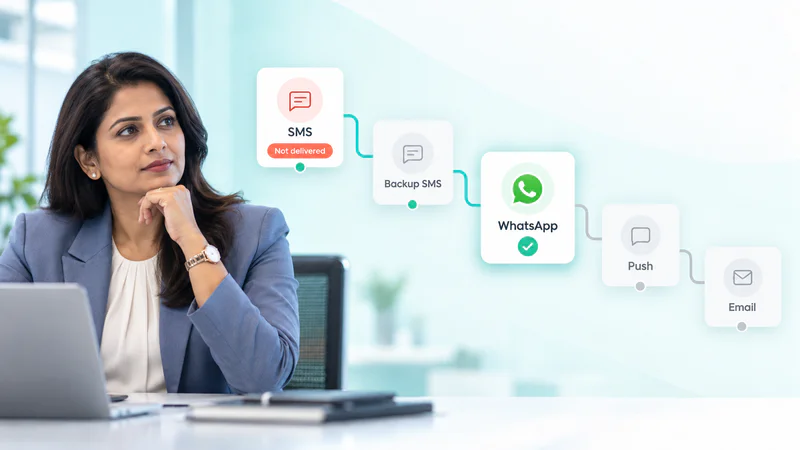
TL;DR
Five questions, in the order a bank has to answer them:
Why SMS alerts fail at Indian banks: the bank’s own source application going down, incorrect phone numbers or email addresses, DLT and variable-tag rejections, DND, coverage and vendor outages.
The fallback order for a bank: SMS, a backup SMS route, WhatsApp, push or in-app, then email, with consent, regulation and template checked before each switch.
How can businesses dynamically switch between SMS and WhatsApp based on cost and deliverability? Regulation and consent set the limits; cost and delivery rates decide inside them.
How can enterprises combine email and SMS for critical alerts to avoid spam filters? Send both for alerts that matter, from an authenticated domain, with alerts kept apart from promotions.
What RBI's 2027 alert rules change for fallback: RBI sets which channels an alert must use. Below ₹500 WhatsApp can carry it; above ₹500 WhatsApp runs alongside SMS.
Why SMS alerts fail at Indian banks
SMS alerts fail to deliver for six reasons:
The bank’s own source application is down. The core banking, card or loan system that triggers the alert fails, and the alert is never generated.
Incorrect customer data. A wrong or outdated phone number or email address on file sends the alert to no one, or to the wrong person.
Untagged templates. Messages whose variables are not pre-tagged are rejected under TRAI’s DLT rules. We covered this in detail in the TRAI variable pre-tagging article.
DND and scrubbing for anything classed as promotional.
No coverage or a switched-off handset.
A vendor or operator route that slows down or goes down.
Fyno handles variable pre-tagging inside its template workflow and validates mobile numbers before a send, which catches untagged templates and invalid numbers before a message leaves the bank. For coverage gaps and vendor outages, Fyno runs real-time SMS failover across vendors: performance is evaluated per send, and underperforming vendors are automatically deprioritised. A source application outage sits upstream of any messaging layer. No fallback can deliver an alert that was
The fallback order for a bank
Automatic channel fallback has three parts: a channel order, a delivery signal and a rule check before each switch. When the first channel does not confirm delivery, the message moves to the next channel the customer can be reached on and has agreed to. For banks, the usual order is SMS, a backup SMS route, WhatsApp, push or in-app, then email.
SMS on the primary route.
SMS on a backup route, through another operator or vendor. How failures are detected and rerouted at this layer is covered in delivery failure detection and automatic rerouting.
WhatsApp, when the customer has opted in and an approved template exists. Fyno connects directly to Meta and manages multiple WhatsApp numbers and vendors, including rerouting when a customer has blocked one of the bank's numbers.
Push or in-app, for customers who have the bank's app. Push reaches the phone at once; in-app shows only when the customer next opens the app, which makes it right for reminders and service messages, not for OTPs.
Email, for alerts that are not time-critical, and always for transaction alerts where the customer's email address is on file.
For service messages where the customer already chats with the bank, the order can start on WhatsApp and fall back to SMS.
In Fyno, this order is a rule the bank's own team sets. When an SMS cannot be delivered, Fyno's cross-channel routing retries it on WhatsApp, email or push, and in-app messaging runs from the same rules. Fyno trains the bank's team, and the team builds its own journeys as needs change.
Three checks before each switch:
Consent: has the customer agreed to this channel? A customer who has opted out of SMS but into WhatsApp gets WhatsApp only. Fyno's consent-based routing reads the customer's preferences at send time and routes only to permitted channels.
Regulation: may this alert move to another channel, or only be sent in addition? (See the RBI section below.)
Template: is the next channel's template approved? DLT for SMS and Meta for WhatsApp, before the fallback is ever needed. Fyno runs one maker-checker workflow that submits SMS templates to DLT and WhatsApp templates to Meta, and tracks each approval. See template management.
If a check fails, the message does not move to that channel.
Three mistakes to avoid:
Sending on every channel at once "to be safe". It multiplies cost and confuses customers.
Two different OTPs. The fallback copy carries the same code and reference as the first attempt, so that a late delivery does not confuse the customer.
One log per vendor. Each vendor sees only its own traffic. Keep one delivery record per message, above the vendor layer. Fyno keeps one audit trail per message across every channel and vendor.
How can businesses dynamically switch between SMS and WhatsApp based on cost and deliverability?
Businesses switch dynamically by setting an order per message type and letting delivery data and cost choose within it. For banks, regulation and consent set the limits first. Cost and delivery rates decide only inside those limits.
Cost pulls the other way from reach. WhatsApp costs more per message than SMS, so fallback should add WhatsApp spend only on the messages SMS failed to deliver, never on every send. The exception is the 24-hour window after a customer messages the bank: service replies inside it carry no template charge, and Fyno's intelligent routing prefers that window over paid SMS when the customer has consented. Fyno also reconciles vendor bills against its own delivery records across operators and channels. More in WhatsApp Business charges for BFSI and WhatsApp vs SMS for loan reminders.
How can enterprises combine email and SMS for critical alerts to avoid spam filters?
Enterprises combine the two by sending both for alerts that matter: SMS for speed, email for the record. Email reaches the inbox when it comes from an authenticated sending domain, carries only transactional content, and is sent to addresses that are kept clean.
Authenticate the sending domain with SPF, DKIM and DMARC.
Separate the streams. Send alerts from a different subdomain than promotions, so that complaints about marketing email do not drag down alert delivery.
Keep alerts plain. No offers or banners inside a transaction alert.
Keep addresses clean. Remove hard bounces and re-verify addresses on a cycle. RBI's 2027 rules ask banks to re-verify mobile numbers and email addresses at set intervals.
For Indian banks, email is not only a fallback. Under RBI's 2027 rules it is mandatory for every electronic transaction where the address is on file, which means the email stream has to be as reliable as the SMS stream. In Fyno, email runs from the same rules as SMS and WhatsApp, and one usage report shows volumes sent, delivered and engaged on every channel, so that a gap in the email stream shows up next to the SMS numbers.
What RBI's 2027 alert rules change for fallback
RBI does not regulate fallback. Its Third Amendment Directions, 2026, which apply to transactions from 1 January 2027, set which channels each transaction alert must use. That limits where a fallback can go.
In Fyno, transaction value can be a condition in the routing rule, so that alerts above and below ₹500 follow different paths without a code change. Fyno's audit trail records every attempt against one message, across SMS, WhatsApp and email. The rules do not say what a bank must do when a mandatory SMS goes undelivered. The full breakdown is in our guide to RBI's transaction alert rules from 1 January 2027.
See how banks run WhatsApp alongside SMS on Fyno's WhatsApp banking page.