Evaluating CPaaS platforms requires dividing them into two categories: Global Infrastructure Giants (Twilio, Infobip, Sinch) and India-Centric Enterprise Aggregators (Gupshup, Kaleyra, ValueFirst). Recent acquisitions like Tata Communications’ purchase of Kaleyra and Tanla Platforms’ acquisition of ValueFirst reshape the competitive landscape significantly. No single vendor solves compliance, cost, and deliverability simultaneously for BFSI. Independent orchestration middleware (Fyno’s model) sits above these vendors to eliminate cost conflicts, automate TRAI/DPDP/RBI compliance, and achieve 100% delivery with failover redundancy.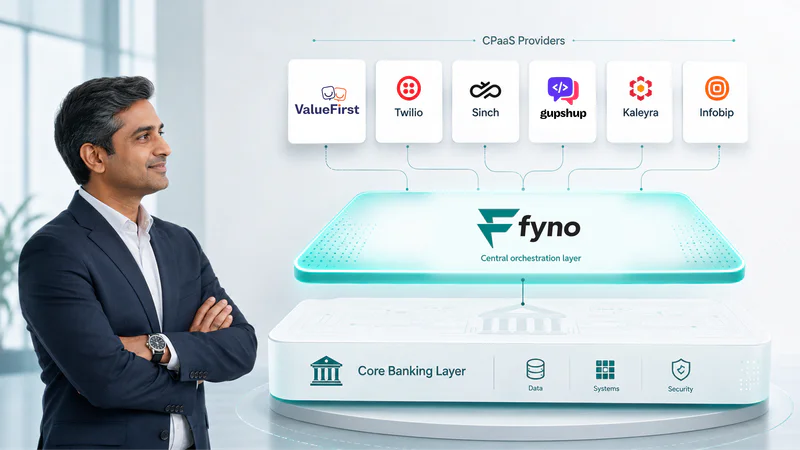
TLDR
In this article we compare six popular CPaaS platforms that serve the Indian BFSI market, each optimized for different use cases.
Valuefirst offers the most cost-competitive SMS pricing due to Tanla’s direct carrier scale.
Twilio excels for developer experience but costs premium for SMS.
Sinch provides mission-critical OTP delivery with robust compliance.
Gupshup leads in WhatsApp automation and conversational AI.
Kaleyra specializes in banking-grade security.
Infobip handles international omnichannel scale.
We also discuss what 400 odd conversations across BFSI reveal about current challenges faced by CIOs, CTOs and Digital Heads in messaging and communication. It reveals multi-vendor management challenges, cost optimisation, compliance and deliverability issues. It also outlines how a middleware like Fyno is able to address these issues.
Comparison Table of top CPaaS players for BFSI, India
The Six Leading CPaaS Platforms for BFSI
Global Infrastructure Giants
1. Twilio: Developer-First, Premium API Platform

The Good: Unmatched software documentation, fast self-serve deployment, excellent developer community, comprehensive global reach, reliable infrastructure.
The Bad: Generally the most expensive option for plain SMS in India. Lacks direct, hands-on support for local Indian telecom compliance (DLT setup). Terrible customer support (top complaint on G2).
Best For: High-tech startups, global applications, teams prioritizing developer experience over cost.
Source:Twilio G2 Reviews, Twilio vs Sinch Comparison, Twilio Alternatives Analysis
2. Sinch/Sinch Hub: Infrastructure-Backed Compliance Leader

The Good: Exceptional delivery speeds and uptime for time-sensitive messages (login OTPs). Specialized Sinch Hub platform coordinates compliance, routing, and DLT scrubbers for enterprise companies. Direct Tier-1 carrier network backing.
The Bad: Standard support can be slow unless your company meets minimum high-volume enterprise spend commitments. Navigating the platform can be complex.
Best For: Ultra-secure transactional messaging, banking OTPs, enterprises with high-volume commitments.
Source: Sinch Why Sinch, Sinch vs Twilio, Sinch Alternatives, Sinch Comparison
3. Infobip: Global Omnichannel Scale

The Good: Highly reliable for international outreach across Europe, Africa, Latin America, and Asia-Pacific. Unifies SMS, Email, Voice, and WhatsApp into functional marketing workflows. Strong delivery reliability (97%+).
The Bad: Overkill and too expensive if your business only requires plain SMS delivery within India. High pricing with aggressive price increases reported by customers.
Best For: International scale, global marketing campaigns, omnichannel requirements beyond India.
Source: Infobip G2 Reviews, Sinch Alternatives, CPaaS Comparison
India-Centric Enterprise Aggregators
4. Gupshup: Conversational AI & WhatsApp Automation Leader

The Good: Top-tier tools for building automated WhatsApp chatbots, AI commerce experiences, and failover automation logic (e.g., resending failed WhatsApp receipts via SMS). Excellent customer support, easy-to-use platform. Strong WhatsApp integration as Meta Tech Partner.
The Bad: Pure SMS pricing includes platform markups, making it expensive for basic text blasts. Dashboard performance issues reported on G2.
Best For: Advanced WhatsApp marketing, conversational AI, chatbot automation, interactive customer experiences.
Source:Gupshup G2 Reviews, Best OTP Providers India, Twilio Alternatives
5. Kaleyra (A Tata Communications Company): Banking-Grade Security

Following its acquisition by Tata Communications, Kaleyra blends direct cloud telephony software with massive global enterprise telecom backing.
The Good: Heavily trusted by financial institutions and banks for security compliance, data localized privacy, and voice-SMS bundle integrations. Easy-to-use interface, responsive customer support, fast template approvals.
The Bad: Platform interface and API feel clunky and legacy-oriented compared to modern developer-friendly options. Time-intensive initial onboarding.
Best For: BFSI, FinTech, heavily regulated sectors, banks requiring banking-grade compliance.
Source:Tata Completes Kaleyra Acquisition, Kaleyra G2 Reviews, Tata Kaleyra Analysis
6. ValueFirst (A Tanla Platforms Company): Most Cost-Competitive SMS

ValueFirst is a veteran Indian enterprise messaging aggregator. Now owned by Tanla - India’s largest CPaaS provider. It controls a massive share of local SMS traffic.
The Good: Offers the most cost-competitive bulk SMS pricing on this list due to Tanla’s direct volume scale with Indian mobile networks. Excellent option for large-scale regional promotional or conversational SMS campaigns. Deep local carrier routes.
The Bad: Lacks polished global dashboard aesthetics and self-serve capabilities found in international competitors. Legacy interface.
Best For: Bulk SMS campaigns, mid-market Indian firms, cost-conscious BFSI looking for SMS optimization.
Source:Tanla Acquires ValueFirst from Twilio, Tanla ValueFirst Acquisition, CPaaS Providers India
The Verdict: Which One Should You Pick?
• Lowest SMS cost in India: ValueFirst, on Tanla's direct carrier scale.
• Best developer experience for global apps: Twilio, at premium pricing.
• Mission-critical OTP delivery with compliance: Sinch.
• Advanced WhatsApp chatbot and automation: Gupshup.
• Banking-grade compliance and security: Kaleyra, Tata-backed.
• International omnichannel scale: Infobip.
For BFSI specifically: pair a low-cost SMS vendor and a WhatsApp automation vendor with Fyno as the independent orchestration layer, so that you remove vendor lock-in and automate TRAI, DPDP, and RBI compliance across all of them.
How Fyno Closes Every Gap: One Orchestration Layer, Three Outcomes

Fyno is not a monitoring add-on. It is a full communication orchestration platform that sits above your CPaaS vendors and connects 100+ providers across 10+ channels through a single API. What a single vendor cannot do alone, Fyno delivers across three outcomes.
Outcome 1: 100% Delivery
Fyno routes around every failure point so that OTPs, alerts, and regulatory notices land every time. Route Builder handles multi-vendor failover, where a failed primary vendor hands off to the next, and cross-channel failover, where a message that fails on SMS goes out on WhatsApp, then push, until it lands.
Configurable retries, rate-limit management, and built-in de-duplication sit underneath. The real-time engine processes 80,000 messages per second at P95 latency under 50ms, with separate priority queues so that a million-message marketing campaign can never delay a login OTP. Vendors can be swapped live from the dashboard with no code change and no redeployment.
Outcome 2: Lower Cost, Provable AI Analytics dashboard
Fyno runs eight cost levers in production, not one or two.
Message-length trimming keeps SMS within a single credit
Least-cost routing sends the same alert through zero-cost in-app or TOTP before falling back to the cheapest vendor, and
Pay-on-delivery blocks invalid numbers before dispatch so that you never pay for undelivered messages
De-duplication alone recovers around 3% of SMS spend.
On the reconciliation side, Fyno matches every vendor invoice line item against its own delivery records in real time and flags overbilling with dispute-ready data.
Across two deployed banks, this surfaced a consistent 3 to 5% gap between Fyno's consumption count and vendor invoices, recovered in full.
Because Fyno earns no delivery revenue, it negotiates directly with telcos and Meta, removing the CPaaS markup. One regional bank CIO reported the monthly messaging bill dropping 15 to 20% after moving traffic through Fyno. WhatsApp Banking adds another lever: utility conversations run free under WhatsApp pricing, saving over 50 lakh rupees annually while delivering app-like journeys on the bank's existing APIs.
Outcome 3: Compliance Enforced at Send, Not Audited After
Fyno validates consent before every single send, not once when the segment or cohort is built. Fyno’s consent management system ensures messaging is managed by topic and channel based on consumer preference. When a customer withdraws consent, suppression propagates across every vendor within seconds.
TRAI DLT templates are validated before send, with long fields trimmed rather than rejected, and RBI promotional-versus-transactional classification is enforced at the router, not left to the sender.
Every send writes one immutable audit record: consent artifact, routing decision, vendor used, and delivery result, searchable in one place for regulators. With the full DPDP compliance deadline set for May 13, 2027, this enforcement is the difference between compliance confidence and compliance risk.
What CPaaS Can't Do vs. What Fyno Does
Why This Matters for BFSI
BFSI teams operate under simultaneous pressure: cost, compliance, and customer experience all matter equally.
Cost pressure: Banks run 4 to 6 vendors to hedge cost and risk. Fyno's reconciliation surfaces a 3 to 5% gap between invoices and actual consumption, and its eight cost levers cut the monthly bill 15 to 20%.
Compliance pressure: TRAI variable tagging (mandatory January 2026), DPDP consent, and RBI audit trails require real-time enforcement. Fyno validates consent before every send and writes one immutable audit log per message.
Customer pressure: OTP delivery is tracked against a 5-second SLA, and transactional alerts against 15 seconds. Meeting it needs multi-vendor routing and automatic failover, not a single vendor.
Single CPaaS vendors excel in one dimension, but cannot solve all three. Fyno's independent orchestration layer does.