DLT registration is how every business that sends commercial SMS in India registers itself, its sender headers, its consent templates and its message templates on a blockchain registry run by the telecom operators, as TRAI requires. For a bank, it is not a one-time setup. It is a running operation across four operator portals, several SMS vendors and hundreds of templates.
Since TRAI's Direction of 18 November 2025, it is also no longer enough for a template to be approved. Every variable in it must carry a type tag, and messages that fail the tag check are rejected. Fyno keeps that check in one layer above the bank's vendors, so that messages stop failing it.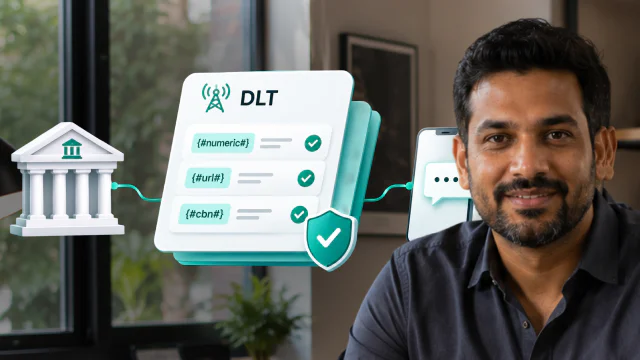
What is DLT registration?
DLT (Distributed Ledger Technology) registration is the mandatory process, under TRAI's TCCCPR 2018 regulations, by which a sender registers on an operator's DLT platform before sending commercial SMS. Messages that do not match a registered entity, header and template are blocked.
A bank registers four things, in order:
Principal Entity: the bank itself, which receives a PE ID.
Headers: the sender IDs customers see, such as a six-letter bank code.
Consent templates: the wording used to capture customer consent for promotional and service-explicit messages.
Content templates: every message the bank sends, with fixed text and variable fields.
Each content template is registered as transactional, service implicit, service explicit or promotional, which decides whether consent and DND rules apply.
Registration happens on the operators' DLT portals: Jio, Airtel, Vodafone Idea and BSNL.
What is the impact of India’s DLT regulations on enterprise messaging strategies?
DLT turns every SMS template into a controlled asset. Nothing goes out unless it matches a registered template exactly, so template sprawl becomes operational risk and template governance becomes a compliance function.
For a bank, that changes four things:
Ownership. One owner for the template inventory across business units. Fyno holds it in one template manager, with a workspace per unit.
Approval. Maker-checker review before changes reach DLT, because a rejected template stops a live alert. Fyno runs this before submission, under its security and governance controls.
Delivery. Registration is not delivery; each message is scrubbed against its template. Fyno's routing passes the DLT template ID with every message.
Hygiene. Unused templates stay registered. Fyno retires them from DLT.
TRAI's variable pre-tagging rule, in one table
TRAI's Direction of 18 November 2025 requires every variable in every SMS content template to be pre-tagged with its purpose. Only data allowed by the tag can fill the variable at send time, and URLs, app links and callback numbers must be whitelisted.
The timeline:
New templates registered from ten days after the Direction must be tagged. Operators applied this from mid-January 2026; Airtel set 14 January 2026.
Existing templates had 60 days from the start of tag scrubbing to be modified.
During those 60 days, failing messages were delivered with fault logs. After that, they are rejected outright.
Operators also now limit new templates to three variables. This is operator practice; the Direction sets no variable count.
Fyno's template manager maps each variable to its TRAI tag when the template is submitted, and checks every link against the whitelist before send, so that a message cannot carry data its tag does not allow.
We explain why this cannot be left to your SMS vendor in Why your SMS vendor can't own DLT template compliance.
Where DLT breaks inside a bank
The double login
A team creates a template on the DLT portal, waits for approval, then recreates or maps it in every SMS vendor's panel. With three vendors, one change is four logins. Fyno removes this: the template is created and approved once, submitted to DLT directly, and used on every vendor.
Approved on DLT, rejected by one vendor
Operators match messages to templates differently. One may accept a close match; another needs an exact one. The same alert can pass on one route and fail as a template mismatch on another. Fyno builds each message exactly to the registered template and passes the DLT template ID with it, so that no lookup is needed.
Variable drift
A bank migrating its core banking alerts found that the variables its source system sent did not match the templates it had already whitelisted. Fyno's template preview tests messages with real values before go-live, which catches drift early.
Unclear ownership
Large lenders now treat DLT operations as a job in its own right. One NBFC asked for DLT as a service. Fyno's role-based access lets a bank give DLT operations to one team while others only send.
What tools help automate DLT template registration and mapping for SMS in India?
Three models exist:
The first two leave the double login in place. A governance layer such as Fyno removes it. What to look for, all of which Fyno provides:
Variable type tagging enforced when the template is created
Maker-checker approval with a full change log
Direct submission to DLT with live status: draft, pending, sent to provider, rejected, approved
Sync to import templates already registered on DLT
The DLT template ID passed with every message
URL whitelisting and domain checks before send
Retirement of unused templates
How can businesses manage multiple sender IDs and headers efficiently?
Map each header to the business unit and the templates it may use, give each unit its own workspace and approval rights, and manage every header from one platform rather than each vendor's panel. In Fyno, each unit's workspace holds its own headers and templates, and role-based access stops one team sending on another's sender ID. Consent templates sit alongside, for promotional and service-explicit traffic. We cover how consent is enforced on every send in How banks manage opt-ins and opt-outs across SMS, WhatsApp and email.
How Fyno runs DLT for banks
Fyno is built for banks and NBFCs. It routes, governs and audits every message. It replaces your CCM and campaign tool, and runs on the CPaaS you already use.
For DLT, that is one template editor, TRAI tags mapped at submission, direct DLT approval, URL whitelisting, MNRL sync and retirement of unused templates. Your team creates every template, so that what reaches DLT is what compliance approved. No rip and replace: your SMS vendors and operator connections stay.