Preface
WhatsApp has become a primary surface where customers experience a brand, especially in high trust categories such as banking. That makes marketing deliverability a strategic lever, not a reporting metric. When messages do not land, the loss is not only reach, it is missed attention in moments where intent exists.
At the same time, WhatsApp marketing delivery is governed by a Meta controlled system that behaves like what’s best described as a black box and continuously adjusts its safeguards to protect the end user experience.
As a result, delivery performance is shaped less by how much you send and more by how intelligently you operate within those constraints.
Introduction
This case study outlines how a prominent bank improved its WhatsApp marketing delivery rate to 76% with Fyno.
The bank’s objective was straightforward, to improve delivery meaningfully without increasing message volume, without risking customer fatigue, and without adding operational complexity for the teams running campaigns.
They achieved this by focusing on 4 execution levers that materially influence outcomes in real deployments.
This blog walks through what was implemented, explains the platform realities that make these choices effective, and then outlines practical best practices that can further amplify performance when applied with the right orchestration layer.
TL;DR
WhatsApp marketing delivery is governed by Meta’s evolving, non transparent eligibility system. Not by spend, volume, or bidding.
A prominent bank improved delivery to 76% by focusing on 4 levers: disciplined WhatsApp auto retries, Duplicate checks, strict DND based send windows, and direct integration with Meta APIs.
Structured retries, specifically 7 attempts spaced 24 hours apart, consistently recovered suppressed deliveries and expanded campaign reach by up to 32% without increasing customer fatigue.
Protecting engagement through DND windows proved as critical as retries, since poor timing weakens future delivery eligibility.
Sustainable delivery improvement comes from orchestrating within Meta’s constraints and continuously tuning strategy based on brand specific engagement data, not from pushing higher message volumes.
The Meta black box
Why is another brand able to deliver more than you?
WhatsApp marketing delivery does not operate like a paid auction where brands can bid for priority. There is no mechanism to buy guaranteed placement in a user’s inbox or to outspend competing brands for reach. Instead, every marketing message is evaluated at send time against Meta’s platform safeguards, and delivery is granted only if the recipient is deemed eligible at that moment.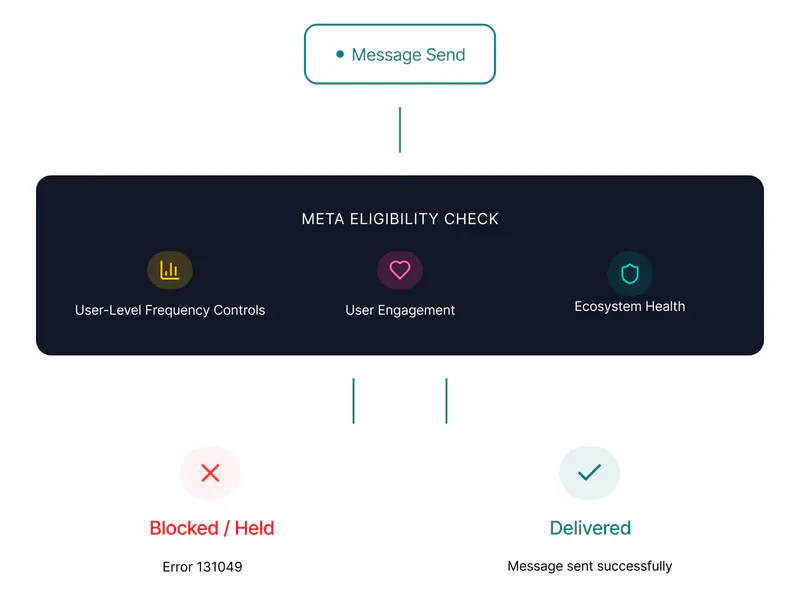
In practice, eligibility is influenced by a combination of factors that Meta does not fully publish, including user level frequency controls, recent engagement behaviour, and ecosystem health signals. The implication is straightforward: higher delivery consistency comes from reducing the reasons a message might be filtered, such as excessive attempts in short windows or poor timing that drives low engagement.
What is dynamic frequency capping in WhatsApp?
In high volume regions such as India, a widely observed benchmark is a perceived cap of roughly 15 marketing messages over a rolling seven day window, applied at the recipient level across all businesses.
If a user receives their fifteenth marketing message on the 3rd day, any additional promotional messages from any brand are blocked until earlier messages age out of that window.
This is not a fixed published limit, it behaves dynamically and is designed to prevent WhatsApp from becoming as cluttered as an email inbox. Users who engage tend to experience a more relaxed threshold, while users who ignore or block brands see the gate tighten.
What does this mean for strategy?
The winning strategy is not intensity.
When a message fails due to frequency capping, Meta returns Error Code 131049 with the message that delivery was blocked to maintain healthy ecosystem engagement. Businesses are not charged for these failures.
From an operational standpoint, immediate retries are counterproductive. Best practice observed in 2026 is exponential backoff, typically retrying after twenty four hours. This aligns retries with the natural refresh of user level quotas and materially improves eventual delivery success.
What did the bank implement to improve delivery?
WhatsApp auto retry - but for real-world frequency constraints
The bank treated delivery as a staged process rather than a single send event. When a marketing message did not deliver on the first attempt, it was retried in a controlled sequence rather than being resent immediately.
A practical operating benchmark we consistently see across campaigns is 7 retries, spaced roughly 24 hours apart. In comparable programs, this retry discipline can expand reach by about 32%.
This cadence performs well because it avoids repeatedly colliding with the same recipient level eligibility window, and it increases the probability of intersecting with a moment when the user is both eligible and active.
Duplicate check - preventing overdelivery in automated systems
A risk with any retry strategy is unintended duplication, where a message succeeds but pending retries still fire, creating avoidable customer irritation.
To prevent this, the bank used duplicate suppression so that once a message was successfully delivered, any subsequent retries for that same event were automatically cancelled. This allowed the bank to pursue higher delivery without increasing perceived noise.
Fyno enforced this as a default safeguard, so teams did not need to manually reconcile what was sent and what should be stopped.
DND windows protect engagement and improve eligibility
The bank enforced DND window, so marketing messages were delivered only during defined daytime hours. Messages that entered the system outside the permissible window were queued and delivered at the next eligible slot.
This is not only a customer experience choice. Late night marketing traffic is more likely to be ignored, and repeated low engagement signals tend to reduce future eligibility.
In effect, night time marketing often gets interpreted as bombardment, even when content and consent are compliant. DND protected engagement quality, which in turn supported more consistent delivery over time.
Direct Meta integration to remove aggregator throttling
The bank chose a direct route to Meta APIs through Fyno rather than routing WhatsApp traffic through an intermediary aggregator. This matters because aggregators can introduce additional throttling layers and queue behavior that are not always transparent, especially at scale.
Fyno being a Meta Tech Partner is the enabler here, it provides access to direct WhatsApp APIs so teams can reduce avoidable constraints that often appear with third party intermediaries.
Results
By combining staged retries, timing discipline, and direct meta integration the bank achieved 76% WhatsApp marketing delivery.
They achieved this without increasing message volume indiscriminately. The uplift came from improving the quality of delivery attempts, protecting engagement signals with DND.
More hygiene practices that improve WhatsApp delivery
Use multiple marketing numbers as a continuity lever
Single sender dependency creates unnecessary risk. A number can face throttling, customer level blocking, or sender health issues that reduce reach in ways that are hard to predict.
If one sender identity encountered constraints, subsequent delivery attempts could be routed through an alternate approved number. This becomes particularly valuable when you are running retries, because it reduces dependency on a single sender identity.
In parallel, it is important to keep transactional and marketing traffic on separate senders. This protects critical communications from any volatility in marketing sender reputation and reduces operational risk.
Use analytics to tune timing and targeting
Do not optimise for delivery alone.
Track engagement by cohort and by send window, then align your retry schedule and channel strategy around where attention and action actually occur.
Analysis of delivery and engagement data showed that late morning to early afternoon consistently yielded higher success rates. While exact timings vary by audience, aligning retries and queued messages to these windows ensured that each attempt had a higher probability of success.
Use omnichannel retry for low engagement segments
If a recipient consistently does not engage with WhatsApp promotions, Meta is structurally less likely to prioritise delivery to that user. In those cases, repeated WhatsApp attempts waste budget and weaken engagement signals.
Even if you are able to achieve a 75% delivery, there’s still 25% of people who you are yet to reach. This is where an alternate strategy would be your best bet.
An effective approach is to shift retries to channels where delivery is structurally more dependable for that cohort, such as RCS, SMS or email.
Learn more about RCS:
RCS vs WhatsApp: Which is better for business messaging?
How fyno makes this repeatable
At scale, the difference between a one off improvement and a consistently high performing WhatsApp program is execution discipline. The bank’s results were driven by retries, DND controls, and direct Meta connectivity, but making those levers repeatable requires an orchestration layer that standardizes the mechanics, reduces operational risk, and keeps optimization grounded in measurable signals rather than intuition.
Fyno enables that repeatability by operationalizing the bank’s approach in a way that remains controlled, automated, and adaptable as campaign volumes and customer behavior change.
Key enablers include:
No Code routing engine that supports disciplined sequencing, including the 7 attempt, 24 hour spacing pattern that consistently expands reach without increasing customer pressure. It also supports retries across multiple approved sender numbers while maintaining one coherent program and reporting view.
Omnichannel failover, low engagement cohorts can be shifted to alternate channels, protecting WhatsApp sender health while still achieving campaign reach objectives.
Direct Meta API access through Meta Tech Partner alignment, reducing avoidable throttling and variability commonly introduced by intermediary aggregators.
Engagement analytics and duplicate suppression, ensuring retries do not translate into repeat impressions, and enabling timing and cohort strategy to be tuned based on observed behavior.
Closing thought
The most reliable way to improve WhatsApp marketing delivery is not to push harder, it is to orchestrate better. When retries are disciplined, when send windows protect engagement, and when the delivery route is free from avoidable intermediary constraints, delivery becomes meaningfully more consistent, even within a black box ecosystem.
At the same time, Meta’s black box is not static. The controls and signals that influence eligibility evolve continuously, which means best practices that work well today are not guaranteed to hold indefinitely. The only sustainable advantage is a feedback driven operating model: routinely analyze delivery and engagement data specific to your brand, isolate what is working for your customer cohorts, and refine timing, retries, and channel strategy accordingly.
The path forward
If WhatsApp delivery is critical to your customer communication strategy, it deserves to be operated with the same rigor as any other core system.
Ready to improve deliverability with an expert led approach? Schedule a demo to see how Fyno’s orchestration helps drive measurable delivery gains in weeks, not quarters.