CCM vs Communication Orchestration Platform for BFSI in 2026
CCMs design the customer journey. Orchestration platforms ensure it actually reaches the customer, compliantly.
TLDR
Traditional CCM systems manage customer engagement workflows but fail at execution-layer challenges like vendor orchestration, real-time compliance, and delivery failures. Communication orchestration platforms handle vendor-agnostic routing, automated compliance, and cost intelligence. CCMs design the customer journey; orchestration platforms ensure messages reach customers while meeting RBI, TRAI, and DPDP requirements.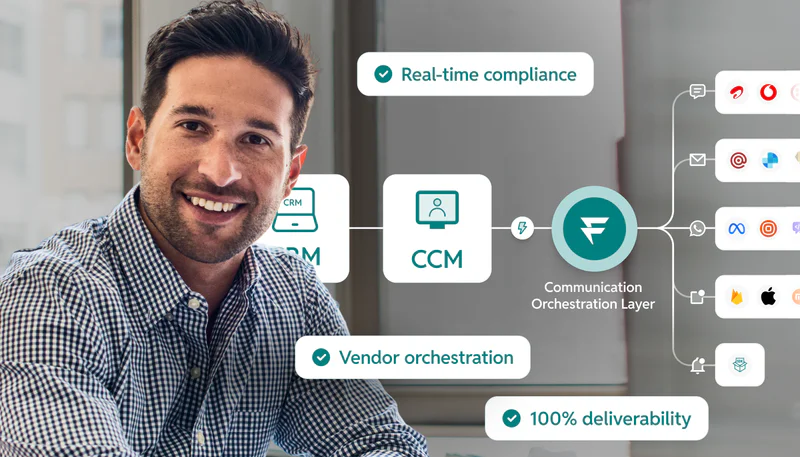
Most BFSI communication failures happen at the execution layer: templates rejected by DLT portals, OTPs failing during vendor outages, compliance violations from recycled mobile numbers, costs spiraling from inefficient routing.
CCM systems excel at engagement strategy - managing customer profiles, designing lifecycle journeys, coordinating marketing campaigns. But when banks, insurers or NBFCs deliver 10-50 million OTPs monthly while maintaining 100% delivery rates, meeting RBI data localization mandates, and preventing ₹2-3 crore quarterly losses, CCMs hit an architectural ceiling.
Communication orchestration platforms handle the execution layer CCMs weren't designed to manage.
What CCMs Do Well (and What They Can’t)
CCM platforms were built for marketing teams to manage customer engagement at scale. Core strengths include customer segmentation, journey orchestration across touchpoints, campaign management with cohort targeting, and template versioning.
Common BFSI use cases: onboarding journeys with KYC and account activation, product cross-sell campaigns, policy renewal reminders, and monthly statement distribution.
The execution gaps emerge when banks need:
Real-time vendor switching for communication delivery,
Compliance automation beyond basic consent tracking,
Failure recovery mechanisms beyond simple retries,
Cost visibility across providers, and
Audit trails that help in compliance challenges from RBI
Most CCMs integrate with a single vendor or maintain static fallback rules. When that vendor experiences regional outages or pricing changes, banks face delivery failures or unexpected cost increases. Engineering teams spend weeks implementing routing changes that business teams could manage in minutes with an orchestration platform.
How Communication Orchestration Solves Execution Problems
Communication orchestration platforms, like Fyno operate as intelligent middleware between banking systems and communication vendors. They address four critical challenges:
Intelligent Routing and Delivery:
Real-time multi-vendor routing switches between providers based on performance metrics, not pre-configured rules. Cross-channel failover moves from SMS to WhatsApp to email within 30 seconds when primary channels fail. Zero single point of failure architecture eliminates vendor dependency risk.
Compliance Automation:
Automated DLT and TRAI validation checks templates before sending. Centralized consent management enforces opt-outs across all channels and vendors simultaneously. Versioned template approval includes maker-checker workflows meeting banking governance requirements. Audit trails capture the "who and why" behind every message decision.
Under the DPDP Act, banks must prove purpose-specific consent. CCM logs show "user opted in." Orchestration platforms answer regulatory queries like "Why was this message classified as transactional?" and "Which system triggered this communication?"
Cost Optimization:
Strategic channel selection routes messages through WhatsApp at ₹0.115 instead of premium SMS at ₹0.40+ when appropriate. Unified vendor reconciliation detects overbilling by comparing contracted rates against actual charges. Protium Finance achieved 40% communication cost reduction through workflow automation.
Data Localization:
On-premise or the bank’s existing cloud deployment keeps sensitive banking data within customer infrastructure. Fyno Connect acts as an intelligent abstraction layer that directly queries bank application databases and enterprise data warehouses (like Athena, Snowflake, Azure, etc) without copying data to external systems. This architecture enables banks to build customer cohorts, segment audiences, and trigger multi-channel communications while maintaining complete data sovereignty. Only routing intelligence passes through Fyno's orchestration layer, meeting RBI data localization mandates and eliminating the primary compliance objection: "We cannot send customer data outside our infrastructure."
Baba Lease and Investment & Shriram Finance both use Fyno Connect to localize their data.
The Architectural Difference between CCM & Communication Orchestration Platforms
CCMs treat communication as a growth lever, optimizing what to say and when. Orchestration platforms treat communication as regulatory liability, deciding whether you're allowed to speak and proving you followed the rules. It also optimizes for deliverability and cost optimization.
This difference cascades through every design decision.
CCMs optimize for engagement, while Orchestration platforms optimize for delivery guarantees and compliance proof
CCMs assume delivery, while Orchestration platforms assume failures and build resilience.
Compliance and Security Standards
Communication orchestration for regulated industries requires ISO 27001 for information security, SOC 2 Type II for operational controls, and GDPR compliance. India-specific requirements include DPDP Act alignment, RBI data localization through on-premise deployment, and TRAI DLT integration with direct template submission.
Security features: end-to-end encryption, data masking and hashing, role-based access controls, HMAC-based signature verification, and complete audit trails that satisfy regulatory requirements.
When Orchestration Becomes Essential for BFSI
Banks, Insurance companies, or even Lending platforms need orchestration platforms when:
Message volumes exceed 1 million monthly
Compliance requires granular audit trails
Engineering teams spend excessive time on vendor management or
Delivery failures impact revenue materially.
The decision point: when CCM communication capabilities create operational debt. Hard-coded routing becomes vendor lock-in. Manual compliance becomes audit risk. Fragmented analytics becomes cost opacity.
What This Means for BFSI Technology Leaders
CCMs remain valuable for designing customer journeys and managing campaign workflows. Orchestration platforms become essential infrastructure for executing communication delivery, automating compliance, optimizing costs, and providing audit-grade visibility.
The question isn't "CCM or orchestration?" It's "How do we protect our CCM investment by adding specialized execution infrastructure?"
Banks processing 100M+ messages monthly in regulated BFSI environments need both layers. CCMs decide what journeys customers experience. Orchestration platforms ensure those journeys reach customers reliably, compliantly, and cost-effectively.
CCM vs Communication Orchestration Platform (BFSI, 2026)
Summary
CCMs excel at customer engagement strategy and journey design but lack specialized delivery controls
Communication orchestration handles vendor management, real-time compliance, failure recovery, and cost optimization
Fyno Connect architecture meets RBI data localization with on-premise deployment
Karnataka Gramin Bank reduced OTP failures 23%; Protium Finance cut costs 30%
Essential for banks processing 10M+ monthly messages with strict compliance requirements