How Leading Banks Achieve ~95% WhatsApp Delivery Through Orchestration
Insights from 100M+ BFSI messages across delivery, compliance, and cost.
Banking IT teams report WhatsApp message delivery rates ranging from 45% for marketing campaigns to 70% as a blended or overall rate. For institutions sending 10 million monthly messages, a 70% delivery rate means 3 million failed messages representing ₹12-15 crore in annual losses. This framework reveals how Tier 1 banks achieve 95%+ delivery through five orchestration components: automated template management, multi-BSP routing architecture, message classification optimization, template health monitoring, and real-time analytics dashboards. 95% delivery rates refer to blended performance across authentication, utility, and marketing messages among eligible, consented users.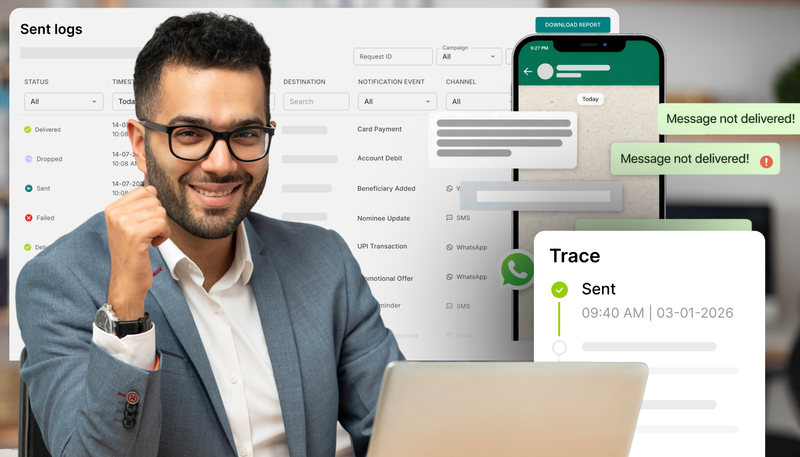
The Hidden Cost of 45-70% WhatsApp Message Delivery
Banking IT teams see the symptoms daily: marketing campaigns with 45-50% delivery rates, transactional alerts reaching only 70% of customers, and unexplained drops during high-traffic periods. Your BSP shows "message sent" status while customers complain about missed OTPs and undelivered transaction alerts.
For a bank sending 10 million WhatsApp messages monthly, a 70% delivery rate means 3 million messages never reach customers. The financial impact includes ₹12-15 crore in annual losses from failed OTPs blocking transactions, undelivered payment alerts triggering customer service calls, and loan disbursement notifications that never reach borrowers.
The counterintuitive truth: WhatsApp message delivery isn't about selecting a "better" BSP. Banks experiencing 45-70% delivery usually work with premium BSPs promising 95%+ performance. The gap exists because deliverability requires an intelligent orchestration layer making real-time routing decisions based on template health, carrier performance, message classification, and BSP availability.
What's Causing Your 45-70% WhatsApp Message Delivery Rate?
Template rejections account for 15-20% of delivery failures when category errors, variable formatting issues, or policy violations trigger Meta's rejection system during the approval stage. Example: submitting "Your loan of ₹5,00,000 has been approved! Click here to proceed" as a Utility template gets rejected because the promotional language and call-to-action belong in the Marketing category. The template cannot be used at all until resubmitted correctly, causing 48-72 hour delays.
Single-BSP dependency creates 8-12% failure rates during provider downtime or regional network issues. A four-hour BSP outage during salary day stops all OTP delivery, blocking authentication and freezing transactions.
Message misclassification explains why transactional alerts show 70% delivery instead of 95%+. This happens after templates are approved, but in the wrong category. Banks add promotional language like "Great news!" or "Wow!" to loan disbursements and account updates, forcing them into the Marketing category when they should be Utility. Marketing templates face Meta's per-user limits (3-5 monthly across all businesses) and deliver at 70-85% rates versus 95-97% for Utility, while costing ₹0.86 instead of ₹0.115 per message.
Template health degradation occurs when previously approved templates get paused weeks later without notification due to quality score issues, causing cascade authentication failures while your dashboard shows normal status.
Contact database clean-up issues create silent failures when banks fail to maintain tags on customers’ phone numbers that aren't registered with WhatsApp, causing messages to appear "delivered" in your system while customers never receive them.
PRO-TIP: Meta limits marketing messages to prevent inbox fatigue. Each user receives only 3-5 marketing conversations monthly from all businesses combined. During festive seasons, your legitimate marketing messages compete with every retailer and service provider for that limited quota.
What's a "Good" WhatsApp Message Delivery Rate?
Authentication messages (OTPs): 98-99.5% delivery is achievable. Anything below 97% indicates serious issues.
Utility messages (transaction alerts): 95-97% delivery represents the target range.
Marketing messages: 70-85% delivery is realistic due to Meta's limits. However, many banks see 45-50% because they send too frequently or trigger spam filters.
Overall blended delivery: 92-95% should be your target. Anything below 88% indicates systemic issues requiring orchestration-level fixes.
If your overall delivery sits below 85%, multiple failures are compounding. Marketing campaigns with 45-50% delivery specifically indicate classification problems combined with Meta's marketing limits.
Automated Template Management: Fixing 15-20% of Failures
Automated template management validates WhatsApp templates against Meta's approval criteria before submission, catching errors that cause 15-20% of delivery failures.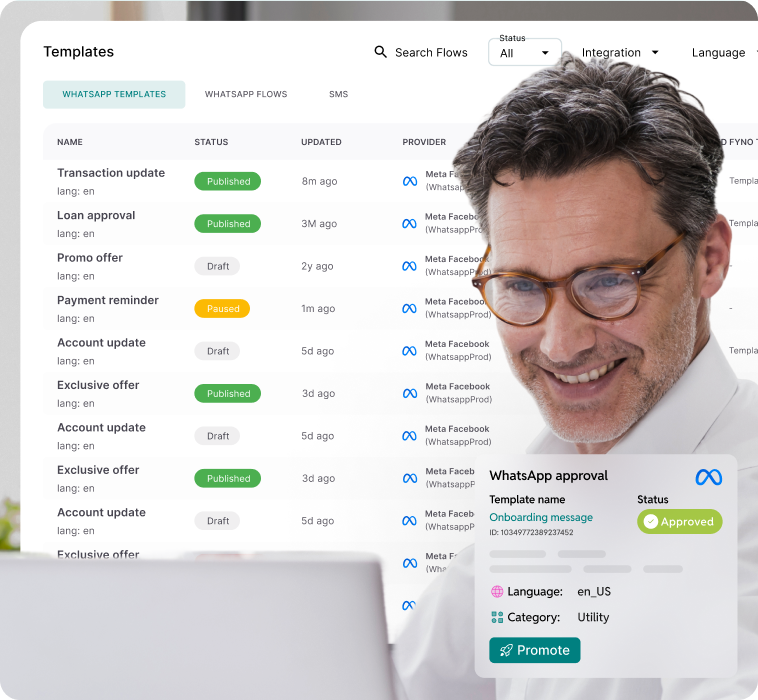
The 5 Critical Validation Checkpoints
Streamlined Content Management ensures template content matches declared categories through Fyno's template creation interface. Utility templates focus on account updates with factual language. Marketing templates clearly promote products with calls-to-action.
Variable format compliance checks that placeholders use consistent { {1} }, { {2} } syntax, date variables specify DD/MM/YYYY format, and currency follows ₹X,XX,XXX formatting. Learn why templates get rejected for formatting errors.
Content policy validation scans for promotional language in non-marketing categories, guaranteed return statements requiring disclaimers, and urgency language triggering spam filters.
URL and attachment rules require full domain names instead of shortened links and verify attachment types match category permissions.
Localization requirements validate that Hindi templates follow Unicode standards and regional languages include English fallback text.
A Tier-1 NBFC reduced rejection rates from 18% to under 2% through automated validation with maker-checker workflows. Within four weeks, dropping approval cycles from 72 hours to 28 hours through automated validation with maker-checker workflows.
Multi-BSP Routing: Eliminating 8-12% Single-Provider Failures
Multi-BSP routing connects your core banking system to multiple BSPs simultaneously, enabling automatic failover and intelligent routing based on real-time carrier performance. Which means messages not delivered on WhatsApp are automatically retried or routed through compliant fallback paths, ensuring no loss of critical customer communication.
The Failure Scenario
Your bank sends 2 million salary credits between 9-11 AM. At 9:47 AM, your BSP goes offline. For four hours, every OTP fails, authentication stops, and you receive 50,000 complaints. With single-BSP architecture, manual failover takes 30+ minutes while you lose ₹12 crore in transaction volume.
The 3 Routing Intelligence Layers
Carrier-level routing examines the recipient's mobile operator and selects the BSP with highest delivery rates. Route Airtel users to BSP-B (97% delivery) instead of BSP-A (89% delivery).
Template-level routing acknowledges different BSPs achieve different approval rates. Marketing templates through BSP-B (94% delivery), OTPs through BSP-A (99.2% delivery, 3-second latency).
Cost-optimized routing balances performance and expense. High-priority OTPs use premium BSP regardless of cost, transaction alerts route through best balance of 95%+ delivery and ₹0.15 cost.
An NBFC, Protium achieved 40% optimization in communication costs by automating workflows.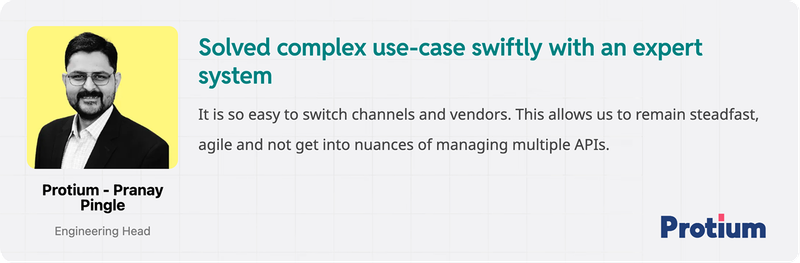
Message Classification: Fixing Marketing Delivery
Meta charges ₹0.86 per Marketing conversation but only ₹0.115 per Utility conversation. Beyond the 7.5x cost difference, Marketing messages face strict per-user limits while Utility messages bypass restrictions entirely.
4 Common Classification Errors
OTP templates with promotional content: "Your OTP is { {1} }. Don't miss our 0% interest offer!" becomes Marketing. Fix: "Your OTP for transaction authorization is { {1} }. Valid for 5 minutes."
Transaction alerts with enthusiasm: "Wow! ₹50,000 credited!" becomes Marketing. Fix: "₹50,000 credited to account ending 4891 on 15/01/2025 at 10:23 AM."
Loan updates with cross-sell: "Your loan is approved! Also, check our insurance" forces Marketing classification. Fix: "Your home loan application HL782934 has been approved. Disbursement within 2 business days."
Payment reminders with persuasive language: "Don't let your credit score suffer!" trigger Marketing. Fix: "Your credit card ending 8829 has a minimum payment of ₹3,450 due on 18/01/2025."
For a bank sending 10 million messages monthly, with 40% misclassified:
Before optimization (10M messages, 40% misclassified):
4M Utility at ₹0.115 = ₹4.6 lakh
4M misclassified Marketing at ₹0.86 = ₹3.44 crore
2M legitimate Marketing at ₹0.86 = ₹1.72 crore
Total: ₹5.21 crore monthly
Delivered: 8.04M messages
After optimization (10M messages):
8M Utility at ₹0.115 = ₹9.2 lakh
2M Marketing at ₹0.86 = ₹1.72 crore
Total: ₹1.81 crore monthly
Delivered: 9.28M messages
Monthly savings: ₹5.21 crore - ₹1.81 crore = ₹3.4 crore
Annual savings: ₹3.4 crore × 12 = ₹40.8 crore
Template Health Monitoring: Catching Silent Failures
Template health monitoring continuously tracks template status, quality scores, and delivery patterns to detect when approved templates get paused.
4 Reasons Templates Get Paused After Approval
Quality score degradation when block rates exceed 0.5% (500+ users per 100,000 block your number).
Policy violations from content drift when variable updates change template meaning.
Merchant quality score issues when your overall business quality drops during seasonal campaigns.
Compliance flags when regulatory monitoring detects potential violations.
The monitoring system polls Meta's API every 15 minutes for status changes, tracks delivery rates against 30-day baselines, and sends automated alerts when delivery drops 5% or quality scores approach thresholds.
Real-Time Observability & Analytics: Enabling 95% Delivery
Unified analytics aggregate performance data across multiple BSPs, providing visibility into delivery rates by carrier, geographic patterns, template performance, and cost metrics.
6 Essential Metrics
Delivery rate by carrier: Jio, Airtel, Vi delivery by BSP and circle. Enables decisions like "BSP-A delivers 97% to Jio but 87% to Airtel—route Airtel to BSP-B."
Template performance: Approval rates, delivery rates, read rates, cost per delivered message by template.
Geographic patterns: Circle-wise delivery, urban vs tier-2 vs tier-3 performance, time-of-day variations.
BSP comparatives: API response times, failure rates, cost per message, quality score impacts by provider.
Real-time queues: Pending messages, processing latency, rate limit utilization, capacity headroom.
Cost analytics: Blended cost per message, cost per delivered message factoring failures, savings from intelligent routing.
Summary: Key Takeaways
Your 45-70% delivery rate indicates multiple compounding failures requiring orchestration-level fixes, not just BSP changes
Template validation prevents 15-20% of failures by catching category errors before Meta rejection
Multi-BSP architecture eliminates downtime risk while enabling carrier-optimized routing that improves delivery 5-8 percentage points
Classification errors force transactional content into constrained Marketing category, reducing delivery from 95% to 70%
Template health monitoring catches silent failures before customer-facing authentication problems occur
Unified analytics enable carrier-level routing decisions that drive 12-15 percentage point improvements
Orchestration adds intelligence above your existing BSP rather than requiring complete infrastructure replacement