Channel orchestration is the new cost control in customer communication
TL;DR
Channel orchestration is the practice of routing every customer message through the best channel for that moment—based on urgency, cost, user preference, and delivery performance. For banks, it’s becoming the new cost-control lever because it reduces SMS overuse, cuts engineering overhead, improves compliance readiness, and prevents revenue loss from missed or ignored messages. Platforms like Fyno operationalize this without constant engineering support.
What does “channel orchestration” mean in banking communications?
Channel orchestration is the process of intelligently routing customer communications through the most cost-effective and effective channel—based on factors like message type, channel/vendor performance, open rates, delivery outcomes, and user preferences. The goal is to maximize reach and reliability while containing costs and meeting compliance requirements.
Channel orchestration vs. multi-channel messaging
Multi-channel messaging is “we can send on SMS, email, WhatsApp, and in-app.” Orchestration is “we know when to send where, and we automate that choice.” In banking, that difference matters because OTPs, fraud alerts, payment reminders, and promotional offers have different urgency, compliance requirements, and ROI—and they shouldn’t share the same default channel.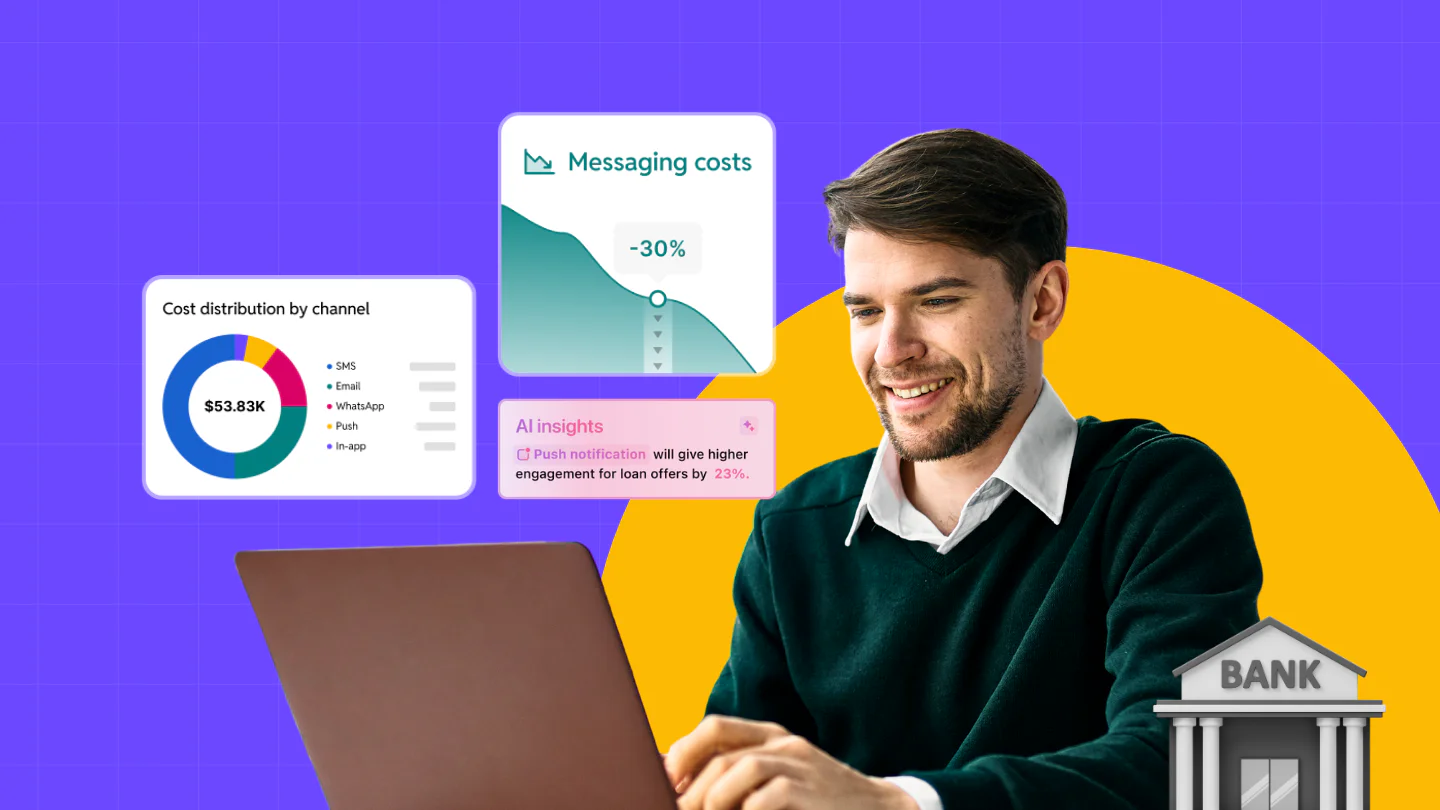
Why is customer messaging becoming a cost center for banks?
Customer messaging is essential, but its cost rises when banks treat channels as disconnected vendor contracts instead of a coordinated system. Costs balloon when workflows default to SMS for everyone, routing logic is hard-coded, and teams spend disproportionate time maintaining integrations, managing templates, and reconciling vendor performance.
SMS sprawl from outdated workflows
SMS remains ubiquitous and is ideal for time-sensitive messages like OTPs and fraud alerts. But many banks still send SMS to all customers regardless of whether they see or need it—driving costs up while engagement stays flat.
Operational drag: engineering, maintenance, and reconciliation
When routing logic is custom-built and distributed across services, teams spend time on maintenance, vendor management, and reconciliation instead of improving customer experience. Lack of behavioral understanding plus engineering effort to implement optimization increases messaging costs and manual work (as stated in the source).
Compliance friction: TRAI DLT and RBI guidance alignment
New compliance guidelines add complexity. The source states that TRAI’s DLT mandates require banks to register SMS templates through telecom providers, adding validation layers. It also notes the RBI doesn’t directly mandate template registration, but has advised banks to align with TRAI norms to reduce fraud risks. Combined requirements for template management, delivery tracking, and auditability make SMS more resource-intensive and harder to scale (as stated in the source).
Why do banks need to diversify across SMS, WhatsApp, email, and in-app?
Banks need channel diversification because no single channel optimizes for urgency, cost, engagement, and compliance at the same time. Diversifying isn’t about replacing SMS—it’s about using each channel where it performs best, then orchestrating the mix so cost and customer experience improve together.
What SMS is still best for
Use SMS for critical, time-sensitive messages where immediacy matters—like OTPs and fraud alerts—especially when the user may not be online or reachable on app-based channels.
Where WhatsApp fits for engagement and utility messaging
WhatsApp has emerged as a powerful alternative that’s more engaging, often cheaper, and increasingly preferred by customers (as stated in the source). It’s now used for transactional and engagement messaging, including transaction alerts, EMI reminders, and onboarding (as stated in the source).
How WhatsApp became a powerful SMS alternative
WhatsApp has evolved from a marketing-only channel into a platform for utility and transactional banking communication, with interactive experiences that can reduce drop-offs and improve conversion.
Open rates, conversions, and WhatsApp Flows
The source claims WhatsApp sees 98% open rates and 40% better conversion than SMS. It also highlights WhatsApp Flows, which enable app-like experiences inside WhatsApp without requiring customers to download a dedicated app.
Channel orchestration is the new cost control
So, instead of picking one channel over the other, banks need to dynamically route messages based on context. That’s where a CCM platform like Fyno proves essential.
With a platform like Fyno, banks can:
Automatically choose SMS or WhatsApp based on urgency, cost, and message type.
Route OTPs through SMS and switch to WhatsApp if delivery fails.
Send utility messages via WhatsApp during the free 24-hour window, and SMS only if the user is unreachable.
Run promotional campaigns with built-in consent logic and spend limits.
Track costs and delivery in real time, with detailed analytics for each vendor and channel.
This orchestration layer transforms messaging from becoming a growing cost center into a full-fledged cost optimisation engine. You can scale without waste, and spend based on what works, not what’s easiest to configure.
The total cost of communication goes beyond price per message
Too often, banks focus on per-message rates and overlook the bigger picture. The real cost of customer communication also includes:
Delays from slow vendor switching
Engineering time spent on routing logic
Compliance overhead from fragmented systems
Missed revenue due to poor engagement
Regulatory penalties from audit gaps
By consolidating channels, templates, and vendor controls into a single orchestration layer, Fyno helps banks cut total messaging costs by up to 40% while improving speed, reliability, and compliance.
What does Fyno deliver?
Fyno is purpose-built for financial institutions that need to modernize communication without rebuilding infrastructure. It consolidates all messaging workflows, templates, vendors, and reporting into one intelligent layer.
Banks that use Fyno typically see:
Up to 40% reduction in communication costs
100% delivery of critical messages like OTPs and alerts
Up to 90% reduction in engineering effort for adding channels or updating templates
Full compliance with RBI, DPDP, and TRAI mandates
Rich analytics for cost reconciliation and audit readiness
With Fyno, banks don’t just reduce spend, they regain control, speed up innovation, and improve the customer experience at every touchpoint.
Conclusion: Move from volume to value
For banks, customer communication will keep growing in volume—but it doesn’t have to grow in waste. Putting an orchestration layer at the center future-proofs your communication stack, improves customer experience, and reduces cost without compromising speed, reach, deliverability, or compliance. If you’re looking to shift from sending more messages to sending smarter messages, orchestration is the control point—and platforms like Fyno are built to operationalize it.