Cost Analysis: Building DPDP Communication Orchestration in-house vs Fyno Integration
You've bought RegTech for consent, but what about enforcing it across channels? Even with CPaaS, DPDP-grade orchestration takes 10–13 months; Fyno delivers it in 4-8 weeks.
TLDR;
Banks implementing RegTech platforms for DPDP consent management solve only half the compliance puzzle. Communication orchestration - the enforcement layer between RegTech and CPaaS - takes 12 to 18 months to build in-house beyond RegTech implementation (18 months total). Fyno runs parallel with RegTech and achieves full compliance in 3-4 months at ₹4-5 crore vs ₹17.5 crore for building, saving ₹12+ crore and 14 months of time.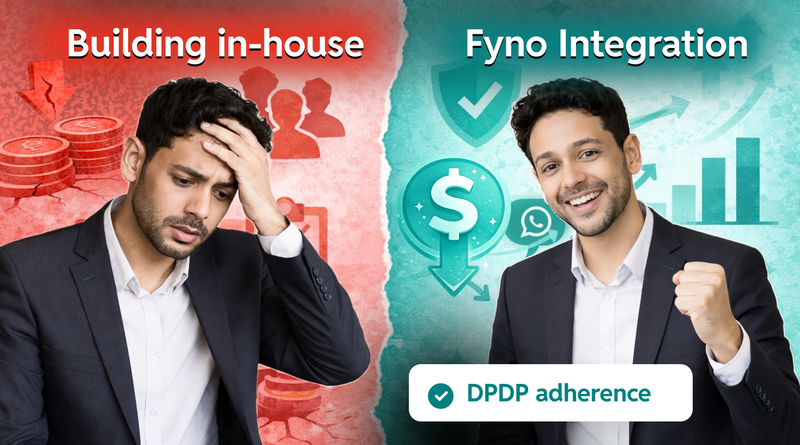
Why are we discussing DPDP compliance?
India's Digital Personal Data Protection Rules mandate full compliance by May 13, 2027 - exactly 18 months from the November 13, 2025, notification. RegTech platforms like IDfy Privy, Leegality, or OneTrust handle consent capture and storage. But they don't enforce consent decisions across your communication infrastructure. That's the communication orchestration layer - and building it in-house takes 13 months beyond RegTech implementation. With Fyno, you run both in parallel and achieve full compliance in 3-4 months.
The hidden complexity: DPDP compliance requires two distinct systems working together:
RegTech platforms (consent governance) capture, store, and manage user consent but don't connect to your SMS gateways, WhatsApp Business API, or email systems.
Communication orchestration sits between RegTech and CPaaS vendors, querying consent status before every promotional send and blocking non-compliant messages.
Most banks assume their RegTech or CPaaS/CCM vendor handles this enforcement layer. They don't.
What Does DPDP Communication Compliance Actually Require?
DPDP-compliant communication requires seven capabilities that span both RegTech and communication orchestration:
Consent capture and storage (RegTech handles this) - IDfy Privy, Leegality, or OneTrust capture user consent, generate legally compliant notices in 22 languages, and store tamper-proof consent artifacts with SHA-256 hashing.
Pre-send consent validation (Communication orchestration - Fyno handles this) - Query RegTech platform's API before every promotional message to verify active consent exists. Block sends when consent is missing or withdrawn.
Message classification (Communication orchestration - Fyno handles this) - Automatically categorize messages as Utility/Service/Authentication (allowed under DPDP "lawful use" without consent) versus Marketing (requires explicit consent). Route accordingly.
Channel-level consent enforcement (Communication orchestration - Fyno handles this) - If a customer consented to SMS but not WhatsApp for promotions, block WhatsApp and route via SMS. RegTech stores the preference; orchestration enforces it.
Delivery audit trail (Communication orchestration - Fyno handles this) - Maintain tamper-proof logs linking each delivered message to consent artifact ID from RegTech platform, showing who received what, when, via which channel.
Consent withdrawal propagation (Both systems) - When a user revokes consent in RegTech dashboard, webhook triggers real-time suppression across all communication systems and CPaaS vendors.
One-Time Notice delivery (Communication orchestration - Fyno handles this) - Send DPDP-mandated notices to 10 million+ existing customers at scale across SMS, WhatsApp, and email with multi-language templates and delivery confirmation.
RegTech platforms handle consent governance.
Communication orchestration platforms handle consent enforcement.
You need both.
Why RegTech Platforms Don't Solve the Communication Problem
IDfy Privy, Leegality, and OneTrust are consent management platforms - not communication platforms. Their scope ends at consent storage. They provide:
Consent collection UI and widgets
Consent artifact storage with legal proof
User-facing consent dashboard
Data Protection Board compliance reporting
Consent Manager registration (₹2 crore net worth requirement)
They do NOT provide:
Integration with Gupshup, Kaleyra, Twilio, or WhatsApp Business APIs
Pre-send consent validation before promotional campaigns launch
Message routing logic across CPaaS vendors
Real-time blocking of non-compliant sends
Channel-level consent enforcement (SMS vs WhatsApp vs Email)
Delivery audit trails linked to consent artifacts
Campaign orchestration across multiple vendors
RegTech vendors will explicitly tell you: "We manage consent. You need a communication platform to enforce those consent decisions across your messaging infrastructure."
That communication orchestration layer is what you must either build or buy. CPaaS vendors like Gupshup don't provide it either - they deliver messages but don't validate consent. The orchestration layer sits between RegTech and CPaaS, creating the enforcement bridge.
Building Communication Orchestration In-House: The 13-Month Reality
Months 1-5: RegTech Platform Implementation (Same for Both Paths)
Select and implement a consent platform. Enterprise deployment takes 3-5 months including CRM integration, consent widget deployment, existing customer data migration, and consent artifact storage setup.
Cost: ₹50 Lacs - 3 Cr for RegTech platform licensing and implementation; depending on the size of the bank and complexity.
This timeline is identical whether you build communication orchestration in-house or use Fyno. The difference is what happens next.
Months 6-12: Communication Middleware Development (Build-Only)
Build the orchestration layer that RegTech platforms don't provide:
Consent API integration framework: Query consent status via REST API before every promotional send
Message classification engine: Automatic tagging of Utility vs Marketing messages based on content analysis and campaign metadata
Channel-level routing logic: If consent exists for SMS but not WhatsApp, route via SMS gateway and block WhatsApp API call
Real-time suppression list management: When consent withdrawn via RegTech platform, webhook triggers suppression across all CPaaS vendors within seconds
Delivery audit trail infrastructure: Log every send with consent artifact ID, timestamp, channel, CPaaS vendor, delivery status
Vendor failover mechanisms: If primary SMS gateway fails, route via backup while maintaining consent enforcement
Development requires 6 senior engineers for 7 months. Cost: ₹4.2 crore (₹1 lakh per engineer per month × 6 engineers × 7 months).
Fyno replaces this entire phase with pre-built orchestration.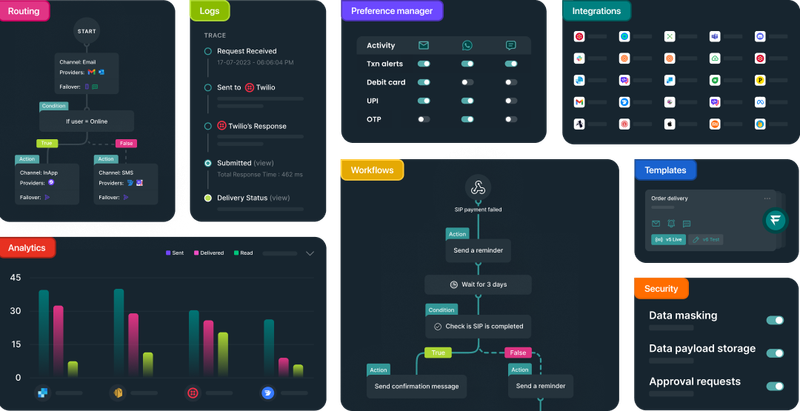
Months 13-16: CPaaS Integration Layer (Build-Only)
Integrate your custom middleware with CPaaS vendors:
Connect to Gupshup, Kaleyra, Twilio APIs with consent validation pre-send checks
WhatsApp Business API integration with Meta's conversation charging logic
Regional SMS gateway integration (BSNL, Airtel, Vodafone-Idea routes)
Cost optimization algorithms (route via cheapest vendor where consent exists)
Rate limit management across vendors
Delivery monitoring dashboards
Development cost: ₹1.5-2 crore for CPaaS integration layer.
Fyno provides 100+ pre-built vendor integrations with intelligent routing.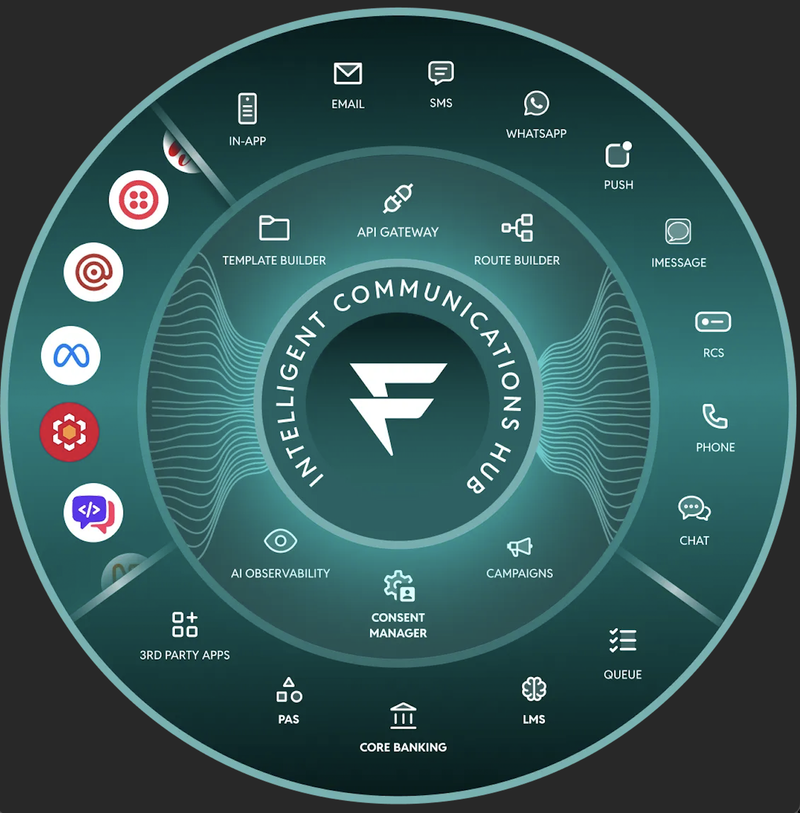
Months 17-18: End-to-End Testing (Build-Only)
Consent validation testing: Verify promotional sends blocked when consent missing
Channel enforcement testing: Confirm SMS-only consent doesn't allow WhatsApp sends
Audit trail validation: Ensure every delivery links to consent artifact ID
Load testing: 10 million+ customer base, peak campaign volume
Data Protection Board compliance documentation
Security certification and penetration testing
Cost: ₹60-80 lakh.
Total timeline: 18 months (5 months RegTech + 13 months communication orchestration build)
Total cost: ₹7.3 crore implementation + ₹3.4 crore annual operations
You miss the May 2027 deadline by 2 months.
How Fyno Runs Parallel with RegTech: 3-4 Month Path to Compliance
Months 1-2: RegTech Selection + Fyno Onboarding (Parallel)
RegTech track: Evaluate and select IDfy Privy, Leegality, or OneTrust. Begin consent platform implementation.
Fyno track (running simultaneously):
Fyno environment provisioned
API credentials configured
Technical team training completed
Existing campaign templates inventoried for migration
Integration architecture designed for chosen RegTech vendor
Outcome: RegTech implementation started, Fyno staging environment operational, integration plan finalized.
Key advantage: Fyno doesn't wait for RegTech completion. Both proceed in parallel.
Months 2-3: RegTech Integration + Fyno Configuration (Parallel)
RegTech track: Complete consent platform deployment, CRM integration, consent widget activation.
Fyno track (running simultaneously):
Connect Fyno to chosen RegTech platform via webhook/REST API
Configure consent validation rules in Fyno orchestration engine
Set up multi-channel routing with consent enforcement logic
Migrate campaign templates from existing CPaaS to Fyno
Configure delivery audit trail reporting linked to RegTech consent artifact IDs
Test consent enforcement in staging environment
Outcome: RegTech operational, Fyno integrated with RegTech API, consent enforcement validated in staging.
Months 3-4: Testing and Production Rollout
End-to-end consent enforcement testing:
Promotional messages correctly blocked for users without consent
Transactional messages (OTPs, alerts) delivered regardless of promotional consent per DPDP "lawful use" exemption
Channel-level consent respected (SMS vs WhatsApp preferences)
Audit trail confirms every delivery links to consent artifact ID
Gradual production migration:
Week 1: 10% of message volume through Fyno
Weeks 2-3: 50% of volume through Fyno
Week 4: 100% of volume through Fyno
Generate compliance documentation for Data Protection Board readiness audit.
Outcome: DPDP-compliant by March-April 2026, with 13-14 months buffer to test all scenarios before May 2027 deadline.
Total timeline: 3-4 months (RegTech and Fyno in parallel)
Total cost: ₹70 lakh implementation + ₹1.2-1.5 crore annual operations
What Is the True Cost of Building vs Buying Communication Orchestration?
Time to compliance:
Build path: 18 months (miss May 2027 deadline by 2 months)
Fyno path: 3-4 months (compliant 13-14 months early)
Hidden costs of building:
Engineering team diverted from core banking innovation for 18 months
Regulatory risk: Each DPDP rule change requires 2-3 month development cycle
Vendor updates: When Gupshup or Kaleyra API changes, custom integration breaks
Scaling complexity: Adding new CPaaS vendor requires 3-4 months custom integration work
Fyno advantages:
Vendor-agnostic: Works with any RegTech (IDfy, Leegality, OneTrust) and any CPaaS (Gupshup, Kaleyra, Twilio)
Automatic regulatory updates: DPDP rule changes implemented across all customers simultaneously
Pre-built integrations: 50+ CPaaS vendors, no custom development required
Engineering focus: Teams stay focused on core banking differentiation
Calculate Your Own ROI
Use this framework to calculate your bank's specific build vs buy economics:
YEAR 0 BUILD COST =
RegTech Platform (₹40-60L) +
Communication Orchestration Development (Number of Engineers × ₹1L/month × 13 months) +
Project Management (20% of development cost) +
Infrastructure (₹50-70L)
ANNUAL OPERATIONS COST (Build) =
Maintenance Team (Number of Engineers × ₹1L/month × 12) +
Infrastructure (₹30-50L annually) +
Vendor Integration Updates (₹40-80L annually) +
Regulatory Updates (₹60-100L annually)
ANNUAL OPERATIONS COST (Fyno) =
Platform Fees (₹1-1.5 crore based on infrastructure required to handle large message volume)
3-YEAR TCO BUILD = Year 0 Cost + (Annual Operations × 3)
3-YEAR TCO FYNO = RegTech Platform + Fyno Setup (₹20L) + (Annual Fyno Fees × 3)
TOTAL SAVINGS = TCO Build - TCO Fyno
TIME SAVED = 18 months - 4 months = 14 months faster compliance
Input your specific numbers: engineer salaries in your market, monthly message volume (OTPs + promotional), existing CPaaS spending, and internal infrastructure costs.
What Happens If You Miss the May 2027 Deadline?
The Digital Personal Data Protection Act specifies penalties up to ₹250 crore per violation for non-compliance. A bank sending 10 lakh promotional messages monthly without valid consent creates 10 lakh potential violations.
Timeline risk comparison:
Build path (18 months):
RegTech operational by June 2026 (Month 5)
Communication orchestration operational by July 2027 (Month 18)
Miss May 2027 deadline by 2 months
Exposure during June-July 2027: 2 months × 10 lakh promotional messages = 20 lakh violations
Even at ₹1 lakh penalty per violation (far below ₹250 crore maximum), exposure reaches ₹2,000 crore
Fyno path (3-4 months):
Full compliance by March-April 2026
Zero violation exposure
13-14 month buffer before deadline
Risk mitigation value for board liability: Immeasurable
Beyond penalties, non-compliance creates:
Reputational damage with customers who care about privacy
Regulatory scrutiny triggering broader RBI compliance audits
Competitive disadvantage as compliant banks market privacy credentials
Board liability exposure for CTOs and compliance heads
When Should Banks Choose Fyno Over Building Communication Orchestration?
Consider building communication orchestration only if you have:
24+ months to deadline (you have 16 months)
₹15+ crore allocated for 3-year TCO
6+ senior engineers available full-time for 13 months (not including RegTech time)
Highly unique communication requirements that generic orchestration can't handle (DPDP applies uniformly - no bank has unique requirements)
Engineering leadership with proven middleware development experience
Fyno makes strategic sense when you need:
Compliance within 16-month deadline ✓ (Fyno: 3-4 months vs Build: 18 months)
Minimized compliance and penalty risk ✓ (13-month buffer vs 2-month violation window)
₹12+ crore TCO savings over 3 years ✓ (₹4-5 crore vs ₹17.5 crore)
Vendor-agnostic flexibility ✓ (Works with any RegTech: IDfy, Leegality, OneTrust, and any CPaaS: Gupshup, Kaleyra, Twilio)
Engineering teams focused on core banking ✓ (Not diverted to middleware development for 13 months)
Automatic regulatory updates ✓ (DPDP rules evolve; Fyno implements changes automatically)
Faster go-to-market ✓ (Launch DPDP-compliant campaigns 14 months earlier)
The reality check:
Most banks assume: "We're implementing reg-tech, so we're DPDP-compliant."
The truth: RegTech handles consent governance. You still need communication orchestration to enforce consent across messaging infrastructure. Building takes 13 months beyond RegTech. Fyno runs parallel with RegTech and completes in 3-4 months total.
The May 2027 deadline creates a forcing function. With 16 months remaining and 18 months required to build, banks choosing the build path will be non-compliant on deadline day. Banks choosing Fyno will be compliant with over a year to spare, at one-fourth the total cost.
The math is unambiguous. The timeline is unforgiving. The decision is urgent.