The challenges of building your own event-based notification service
TLDR: The real challenge with event-based notifications
Event-based notifications start simple, then quietly become infrastructure: listeners, data transformations, routing rules, fallbacks, and endless edge cases. When events come from Mixpanel, Stripe/Razorpay, logistics partners, and more, “send a message” becomes “maintain a system.” Fyno’s approach is to centralize this via one endpoint + configurable workflows.
Your product is a complex ecosystem.
User actions flow through platforms like Mixpanel, payment moves through Stripe or Razorpay, packages ship via logistics partners, and data streams in from a dozen other services.
Every click, swipe, and transaction is a potential touchpoint for customer communication. A signup needs a welcome message. A payment deserves a confirmation. A delivery status change warrants an update.
But connecting these scattered data points into meaningful customer communications needs a lot of resources and engineering effort.
And let's be honest – your engineering team has better things to do than converting and piecing together data from multiple sources and building workflows around them.
What if you could just forward your event data to a single endpoint and let the platform handle everything else?
I’ll get to that.
But, let me take a step back and go a little deeper into the challenges of building your own event-based notification service.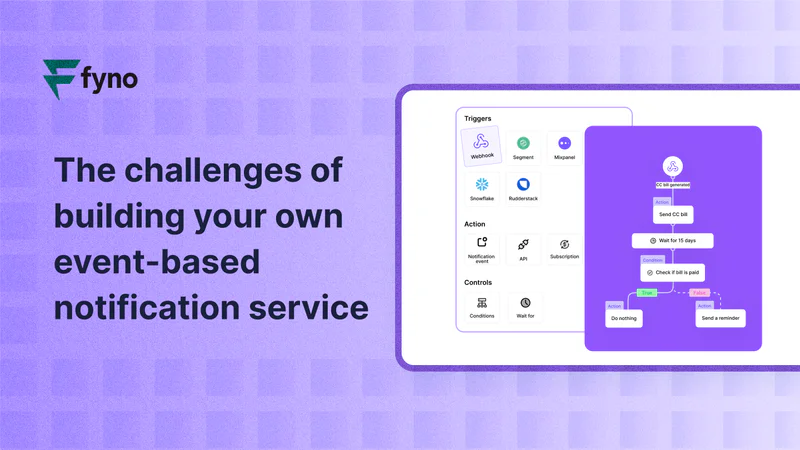
The challenges that come with building your own event-based notification service
"We never expected this! What started as a simple function to send welcome emails has evolved into a massive spaghetti of code containing event listeners, data transformers, and channel routers."
If you’d come across this statement at least once from your team members or if you’re the one who’d said it, then you know what I’m talking about.
If you’re seeing a good amount of growth in your user base, then it's not just about sending messages anymore.
It's about sending meaningful, contextual notifications for various user actions. You went from building a basic function to send simple messages, to managing an entire communication infrastructure. An infrastructure that demands constant attention, updates, and optimization.
Imagine a world where your engineers could focus on building features that matter. Where adding a new event-based notification flow doesn't require a sprint. Where connecting a new data source or communication channel takes minutes, not weeks.
Today, you don’t have to imagine. Because, you have Fyno.
Fyno helps you simplify your communication infrastructure
Fyno provides a unified API endpoint that allows you to forward event data from any source. And, everything from ingestion and transformation of event data, to triggering routing flows happens automatically.
How does Fyno work?
Forward all your event data to Fyno’s unified endpoint.
After forwarding all your event data to Fyno, you can define event triggers and their corresponding notification events using our simple yet powerful workflow builder.
Fyno will automatically extract relevant notification variables from the incoming event data, look for triggers, and execute the defined notification events.
Once these notification events are triggered, they’ll make sure that your message reaches your customers on their preferred channel. All you have to do for this to work is add the content for the notification as a template and define the routing flows.
If you need additional context for a scenario within the workflow, you can call any external or internal API.
ll you have to do is set it and forget it. Everything else will be taken care by Fyno. No sprint cycles. No code changes. And no more worrying about deadlines.
Let’s look at an example to understand this better.
When a payment succeeds in Razorpay, the webhook doesn't trigger a cascade of internal services. Instead, it flows directly to Fyno. The raw event data arrives carrying all the essential information – transaction amount, customer details, timestamp.
But what happens next is where the magic unfolds. Without writing a single line of code, you've already defined how this event should be handled. Your payment success template stands ready, waiting to transform raw data into personalized messages.
Your channel sequence is predetermined – try WhatsApp first, fall back to SMS if needed, follow up with email for good measure. Fyno will execute this notification event and send a payment confirmation message to your customer via WhatsApp.
What makes Fyno the perfect choice for an event-based notification service?
Smart channel switching
When a critical alert needs to go out, Fyno doesn't blindly fire it through every available channel. It orchestrates a strategic sequence, which you can help set up.
You can try sending the notification through WhatsApp first—it's cost-effective and immediate. No response in 30 seconds? You can tell Fyno to switch to SMS. Still nothing? You can trigger an email and create an in-app notification as a backup. This isn't just automation; it's intelligent communication flow. This way, you achieve a 100% deliverability.
Built for scale
As your product grows, so do your communication needs.
New events emerge. New channels gain popularity. New regions require different approaches. With a traditional notification infrastructure, each change ripples through your codebase, demanding updates and testing.
But with consolidated event-based notification services like Fyno, scaling becomes seamless.
Recommended Read: How to build a scalable notification service? A developers' guide
Got a new event source? Point it to Fyno’s endpoint. New channel? Add it to your workflow within Fyno. New region? Adjust your routing rules.
As simple as that.
The path forward
Event-based notifications aren't just about sending messages – they're about building a scalable, maintainable communication infrastructure that grows with your business. By separating your event handling from your core application logic, you create a more flexible, future-proof system.
Stop building custom notification pipelines. Let your engineering team focus on your core product while Fyno handles the complexities of event-based communication. Your developers will thank you, and your customers will enjoy a more seamless communication experience.
Ready to transform your notification infrastructure? Schedule a demo with Fyno to see how it works.