For banks, NBFCs and insurers: how reaching each customer on the right channel improves their experience and lowers what it costs to reach them.
Fyno defines opti-channel communication as sending each message on the one channel most likely to reach that customer for that type of message, and adding a second channel only when the first one fails. It replaces the habit of sending the same message everywhere "just in case". The result is fewer messages per customer, which is where the saving and superior customer experience comes from.
The decision is made per message. Fyno reads the message type, the customer's consent and channel history, and the bank's rules, then picks the first channel. Regulated messages, such as OTPs and transaction alerts, always go on the channels the regulator requires. For everything else, a second channel fires only if the first is not delivered, and within each channel the message goes to the cheapest vendor that meets the bank's delivery threshold.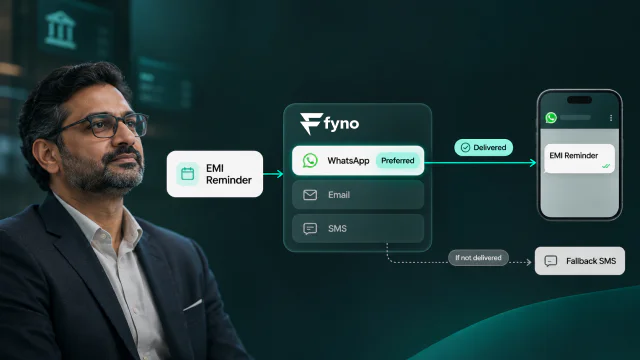
TL;DR
Seven questions, from the definition to running it in production. The second one covers how opti-chammel communication also reduced messaging costs.
What is opti-channel communication? The definition, and the three inputs it uses.
What is opti-channel routing and how does it reduce messaging costs? Why the saving comes from sending fewer messages, not cheaper ones.
How is opti-channel different from omnichannel? Being on every channel versus choosing one.
How can businesses choose the right channel mix for different types of customer messages? What the customer notices, and which channel fits which message.
How does opti-channel work for banks and NBFCs? An EMI reminder journey, worked through.
What does it take to set up opti-channel communication? The data, integration and governance it needs.
How does Fyno run opti-channel communication? Where Fyno sits and what it decides on each send.
What is opti-channel communication?
Opti-channel communication is a way of sending customer messages in which each message goes on the single best channel for that customer and that purpose, at the right time, with a planned fallback if it fails. It uses three inputs: the type of message, the customer's consent and preferences, and how that customer has responded before.
The three inputs, in practice:
Message type. An OTP, a transaction alert, an EMI reminder and a festive offer have different urgency, different rules and different acceptable costs.
Consent and preference. Which channels the customer has agreed to, and which they have asked for. Consent is enforced at the moment of send.
Past behaviour. Whether this customer reads WhatsApp, opens email or uses the app. A customer who has not opened an email in a year should not get the reminder by email first.
What is opti-channel routing and how does it reduce messaging costs?
Opti-channel routing is the logic that picks the first channel for each message and decides when, if ever, to use a second. It reduces messaging costs by sending fewer messages, not always cheaper ones: it removes duplicate sends, fires a fallback only when the first channel fails, and routes each send to the lowest-cost vendor that meets the delivery threshold.
Three levers do the work:
Duplicate suppression. Loan, CRM and core systems often trigger the same message for the same event. Blocking the copies before they leave removes messages that should never have been paid for.
Fallback only on failure. "Send everywhere" pays for every channel on every message. Opti-channel pays for the second channel only for the customers the first one missed.
Least-cost routing within a channel. Most banks run several SMS vendors. Each send goes to the cheapest vendor that is currently meeting the delivery threshold, rather than to a fixed split.
What opti-channel does not do is cut cost by moving regulated messages to a cheaper channel.
OTPs and transaction alerts stay on the channels the rules require. Across production deployments, Fyno sees a 15 to 25% reduction in messaging spend from these levers combined. For the SMS side in detail, see how to cut SMS costs in India without hurting delivery.
How is opti-channel different from omnichannel?
Omnichannel means a brand is present and consistent on every channel. Opti-channel means each message uses the one channel that works best for it, with a fallback. Omnichannel is about coverage; opti-channel is about choice. A bank can be omnichannel and still overspend, because being on every channel often turns into sending on every channel.
How can businesses choose the right channel mix for different types of customer messages?
Start from the message, not the channel. Sort messages by urgency and by what the rules require, then let each customer's consent and behaviour pick the channel for everything that is not regulated. For a bank customer, experience improves when they get one message, on a channel they read, at a useful time.
What the customer notices:
One message, not three. When the same alert arrives by SMS, WhatsApp and email, customers start to ignore all of them, and a repeated payment or security alert can look like fraud.
The channel they actually read. An EMI reminder goes in the app for an active app user, on WhatsApp for a customer who reads it, and by SMS for everyone else.
The right moment. Reminders are timed to when the customer acts, and urgent messages, such as OTPs, go at once on the fastest reliable route.
Their choices were respected. A customer who has opted out of a channel never hears from it, because consent is checked at the moment of send.
A channel mix by message type:
OTPs: SMS first, with a second route only where delivery data shows SMS falling short.
Transaction alerts for banks: email for every electronic transaction and SMS above ₹500, with push, in-app or WhatsApp only as additions.
EMI, renewal and statement reminders: the channel the customer responds on, with SMS as the fallback if it is not delivered.
Offers and cross-sell: consented marketing channels only, with no fallback.
Fyno applies the mix the bank sets to every message. Customers get fewer, better-timed messages, and the bank pays for fewer sends.
How does opti-channel work for banks and NBFCs?
It works message type by message type. Regulated messages follow the rules: for banks, from 1 January 2027 the RBI's alert directions require email for every electronic transaction and SMS above ₹500. Service and engagement messages, such as EMI reminders, follow the customer: the first channel is the one they use, and a second fires only if it fails.
A worked example, using an NBFC's EMI reminder three days before the due date. The numbers are an illustration, not customer data.
Lower-priority messages can start on in-app or push, which cost nothing per message, and fall back to WhatsApp or SMS only when the customer cannot be reached there. The payment confirmation that follows is a regulated alert for a bank and goes on the required channels regardless. The full RBI breakdown is in Fyno's guide to the RBI transaction alert rules.
Opti-channel only saves money if any WhatsApp leg is categorised and priced correctly, because a utility template that Meta reclassifies as marketing costs far more. More on WhatsApp Business charges for BFSI.
What does it take to set up opti-channel communication?
Three things: clean customer data that every sending system can read, one integration point in front of all channels and vendors, and rules the bank owns and can change. Most banks have the first in pieces across CRM, loan and core systems. The second and third are where projects stall.
Data. Consent, channel preference and response history usually sit in different systems. Opti-channel needs one view of them at the moment of send.
Integration. If every system integrates directly with every vendor, changing a channel decision means changing code in each system. A control layer in front of the vendors lets the decision change in one place.
Governance. Compliance teams need to see which channel each message used and why. Every decision should leave an audit-ready trail.
How does Fyno run opti-channel communication?
Fyno sits downstream of the bank's core data systems, replacing a CCM, and upstream of its CPaaS vendors. Every message passes through it. On each send, Fyno checks consent, blocks duplicates, picks the channel by the bank's rules, routes to the best-performing vendor at the lowest cost, and records the outcome.
The bank keeps control of the logic. Fyno's team trains the bank's team, and the bank builds and changes its own journeys as needs evolve. Inside those rules, vendor performance is evaluated per send and underperforming vendors are automatically deprioritised. Existing CPaaS vendors and their contracts stay, and Fyno connects them. More on how Fyno's intelligent routing works and Fyno's cost optimisation for BFSI.
Summary
Opti-channel communication sends each message on the one channel most likely to reach that customer, with a fallback only if it fails.
It saves money by sending fewer messages, not cheaper ones: duplicate suppression, fallback on failure and least-cost routing within a channel.
Regulated messages, such as OTPs and transaction alerts, stay on the channels the rules require.
Omnichannel is about being on every channel; opti-channel is about choosing one per message.
Customers get one message instead of several, on a channel they read, at a useful time, with their consent respected.
It needs one view of consent and preference, one integration point in front of all vendors, and rules the bank owns.
SMS billing, reconciliation and vendor routing are covered in detail in Fyno's guide to cutting SMS costs in India.