The CPaaS industry: Driving growth with unified customer communication APIs
The Communications Platform as a Service (CPaaS) industry is experiencing rapid growth. Gartner forecasts that 90% of global enterprises will use CPaaS for customer experience and engagement by 2028, up from 50% in 2023. The increasing variety of communication channels drives this expansion.

Understanding CPaaS
Communications Platform as a Service, or CPaaS, enables engineering and product teams to embed real time and asynchronous communication capabilities directly into their digital products without building telecom infrastructure from first principles. Instead of managing carrier relationships, routing logic, delivery retries, compliance workflows, and channel specific APIs in house, teams consume programmable interfaces, SDKs, and orchestration layers exposed by the CPaaS provider.
For Engineering Managers and Technical Product Managers, CPaaS is fundamentally an abstraction layer over fragmented communication ecosystems. It provides APIs for message creation, delivery tracking, user identity management, consent handling, and event based triggers, along with SDKs and in certain cases low code builders to accelerate implementation across web and mobile applications.
Below is a deeper view of the core channels typically supported by CPaaS platforms.
SMS: Sending and receiving text messages
SMS enables businesses to send concise, high reach text messages directly to users’ mobile devices without requiring internet connectivity. It is widely used for transactional alerts, one time passwords, service notifications, and time sensitive updates due to its strong deliverability and immediacy. Two way SMS also allows customers to respond, confirm actions, or interact with automated workflows.Email: Facilitating email communication
Email supports structured, content rich communication such as account updates, billing statements, onboarding flows, and detailed notifications. It allows for longer form messaging, attachments, and branded templates, making it suitable for both transactional and informational use cases. Delivery tracking and engagement analytics provide visibility into opens, clicks, and user behavior.Push notifications: Delivering alerts to mobile devices
Push notifications are real time alerts delivered through mobile operating systems such as Android and iOS. They are commonly used for reminders, transactional updates, and engagement prompts, even when the user is not actively using the app. Rich push capabilities can include images, action buttons, and deep links that drive users back into specific app screens.In app messaging: Enabling direct communication within apps
In app messaging displays contextual messages to users while they are actively using an application. These messages can guide onboarding, highlight new features, or provide contextual support without interrupting the user experience outside the app. Because they are behavior driven, they can be highly personalized and event triggered.Voice: Making and receiving voice calls
Voice communication enables applications to initiate outbound calls or receive inbound calls through programmable telephony interfaces. It is particularly relevant for escalations, verification workflows, and customer support scenarios where real time interaction is required. Advanced capabilities can include interactive voice response menus, call recording, and transcription.WhatsApp: Leveraging WhatsApp for customer interactions
WhatsApp allows businesses to communicate with customers over a widely adopted messaging platform with support for multimedia and interactive elements. It enables both structured outbound notifications and two way conversational messaging within policy defined windows. Features such as quick reply buttons and media sharing enhance engagement compared to traditional text messaging.Rich Communication Services, RCS: Enhanced messaging capabilities with rich media
RCS upgrades traditional SMS by supporting branded sender profiles, high resolution images, carousels, and interactive buttons within the native messaging inbox. It enables a more app like experience without requiring users to download a separate application. Where unsupported, messages typically fall back to SMS to preserve delivery reach.
The need for unified customer communication APIs
Unified APIs aggregate these diverse communication services into a single, cohesive interface, offering numerous benefits:
1. Streamlined Integration: Simplifies integrating multiple communication channels.
2. Consistency: Provides a uniform interface, reducing development complexity.
3. Security: Enhances security with features like PII masking and one-way datahash.
4. Improved Developer Experience: Comprehensive documentation and support libraries streamline development.
Benefits of unified APIs in CPaaS
Efficiency: Simplifies the development process by providing a single access point.
Cost-effectiveness: Reduces development and maintenance costs.
Scalability: Easily scales communication functionalities to meet business growth.
Future-proofing: ensures compatibility with evolving technologies and standards.
Omni-channel communication management: Solves omni-channel communication management problems with a plug-and-play platform.
Timely deliverability: Ensures timely and 100% deliverability of communications across any channel.
Detailed reporting: Provides curated, detailed, and consolidated reports for all communications and notifications at a user level.
Cost-effective channels: Enables cost-effective alternative channels like In-App and Push notifications for mobile app users.
Customer preferences management: Allows building, offering, and managing customer preferences regarding which channels they want to receive specific communications.
How fyno can help
Fyno is a modern communication platform that helps mid-market and enterprise companies consolidate their multi-channel product communications in one place using a single API. Critical features of Fyno include:
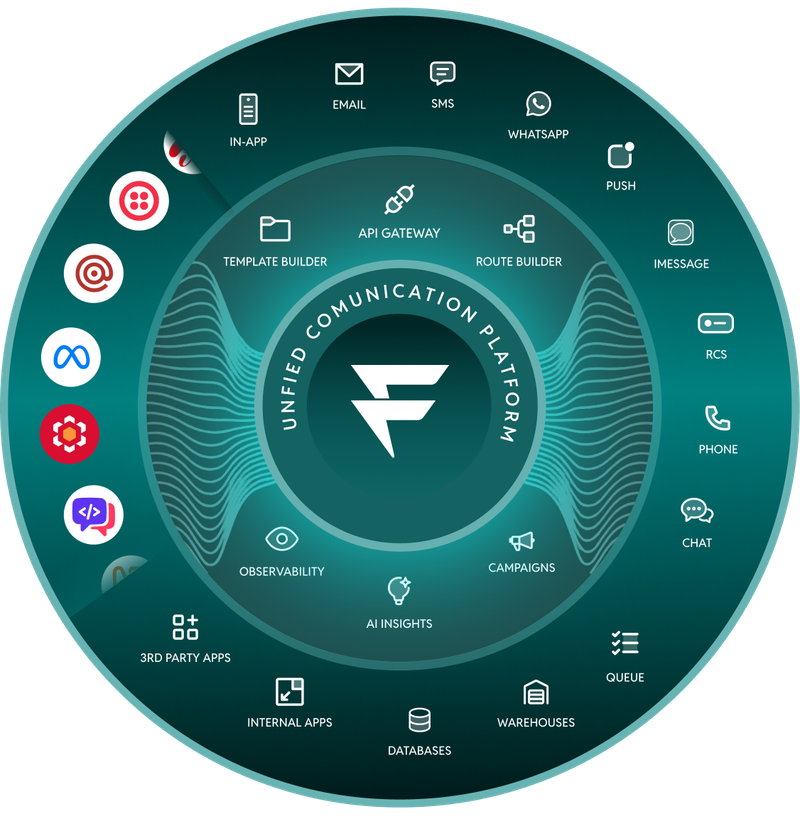
No-code orchestration layer: Easily create and send notification flows in just a few minutes.
Intelligence layer: Track, measure, and improve communication experiences with integrations, template management, and a powerful workflow builder.
Scalable enterprise-grade system: Fyno offers a communication system that can grow with your business needs, ensuring scalability and reliability.
FAQs
1. What is CPaaS?
CPaaS (Communications Platform as a Service) allows businesses to integrate various communication features into their applications using APIs, SDKs, and no-code/low-code builders.
2. What are Unified Customer Communication APIs?
Unified Customer Communication APIs aggregate diverse product communications into a single, cohesive interface, simplifying integration and providing a uniform interface.
3. What are some key communication channels supported by CPaaS?
Key communication channels supported by CPaaS include SMS, Email, Push Notifications, In-App Messaging, Voice, WhatsApp, and Rich Communication Services (RCS).
4. What are the benefits of using Unified APIs in CPaaS?
Benefits include streamlined integration, consistency, enhanced security, improved developer experience, efficiency, cost-effectiveness, scalability, future-proofing, omnichannel communication management, timely deliverability, detailed reporting, and cost-effective channels.
5. How does Fyno help businesses with communication needs?
Fyno consolidates multi-channel product communications in one place using a single API, featuring a no-code orchestration layer, an intelligence layer for tracking and improving communications, and a scalable enterprise-grade system.
Comments
Your comment has been submitted